There is a moment in the spiritual life that many Catholics experience but few know how to explain.
You kneel down to pray.
You open the Bible.
You begin the Rosary.
You attend Mass.
But something seems different.
You feel nothing.
The words are there, but your heart seems distant.
The prayers that once brought peace now seem empty.
You ask God for help, but you do not perceive an answer.
And perhaps a frightening question begins to grow inside you:
“Has God abandoned me?”
If you have ever experienced this, you are not necessarily losing your faith.
The Catholic tradition calls one form of this experience spiritual dryness, and the Catechism of the Catholic Church explicitly recognizes dryness as one of the principal difficulties encountered in prayer. The Catechism teaches that, in such moments, faith can become purer because the person remains faithful to Jesus even without spiritual consolation.
This is where the witness of Saint Charbel Makhlouf becomes particularly meaningful.
His life was marked by silence, prayer, solitude, Eucharistic devotion, humility, sacrifice, and a hidden search for God.
And his example reminds us of something essential:
The absence of spiritual feelings is not the absence of God.
📚 This article is part of the Ultimate Guide to St. Charbel
If you want to discover the complete story of St. Charbel Makhlouf—from his childhood, religious vocation, and monastic life to the miracles recognized by the Church, the mystery of his incorrupt body, his prayers, the novena, his powerful intercession, and his extraordinary path to holiness—be sure to visit our Ultimate Guide to St. Charbel, the most comprehensive resource on our website about this beloved Maronite saint.
Deepen Your Faith with the Story of Saint Charbel
If you were moved by this article, discover the complete journey of faith, silence, and supernatural healings in The Life and Miracles of Saint Charbel by Wander Venerio Cardoso de Freitas.
Discover how a humble Lebanese hermit became one of the Catholic Church’s greatest miracle workers.
Explore the documented miracles and official healings recognized by the Church. Renew your daily prayer life with timeless spiritual lessons.
🛒 [Get Your Paperback / Kindle Copy on Amazon]
What Does the Bible Say When We Feel Nothing in Prayer?
The Bible does not present prayer as a permanent experience of emotional consolation.
In fact, Scripture contains many prayers born from anguish, silence, waiting, and apparent abandonment.
The Psalms are perhaps the clearest example.
The psalmist cries:
“How long, O Lord?”
This is not the prayer of someone who has stopped believing.
It is the prayer of someone who continues turning toward God while suffering God’s apparent silence.
The Catechism teaches that the Psalms express virtually every human experience before God: joy, suffering, thanksgiving, fear, lamentation, hope, and waiting. They remain an essential part of the prayer of the Church.
Therefore, when you cannot find your own words, you can borrow the words of Scripture.
Pray Psalm 23.
Pray Psalm 27.
Pray Psalm 42.
Pray Psalm 63.
Pray Psalm 130.
You do not need to pretend that everything is fine.
Bring your real heart before God.
Even Jesus Experienced the Agony of Prayer
One of the most important Catholic truths about spiritual dryness is found in the prayer of Jesus Himself.
Before His Passion, Jesus entered the Garden of Gethsemane.
He did not pray from emotional comfort.
He prayed in anguish.
He said:
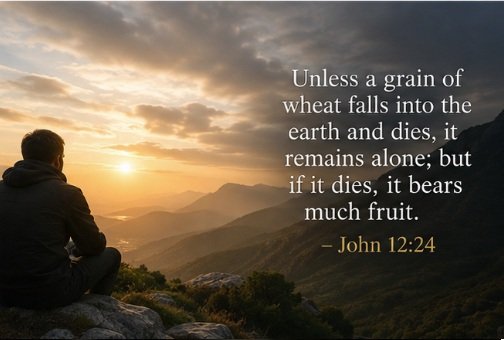
“My soul is very sorrowful, even to death.”
And then:
“Not my will, but yours, be done.”
This is extraordinarily important.
Jesus’ prayer demonstrates that authentic prayer is not measured by how peaceful we feel.
The Catechism presents Christ’s prayer in Gethsemane and His words on the Cross as the deepest revelation of His filial prayer to the Father. His prayer expresses complete trust and obedience even in suffering.
Therefore, when you pray without consolation, you are not necessarily praying badly.
Sometimes you are learning to pray more like Christ.
Spiritual Dryness Is Not the Same as Losing Faith
This distinction is crucial.
You can experience spiritual dryness and still possess faith.
You can pray without feeling anything and still love God.
You can experience God’s silence and still trust Him.
Faith is not simply an emotion.
Catholic faith is a response to God who reveals Himself and invites man to communion with Him.
The Catechism explains that Christian prayer involves faith, trust, humility, vigilance, and perseverance.
This means that sometimes your most beautiful prayer may not be the prayer in which you experience the greatest consolation.
It may be the prayer in which you simply remain.
You kneel.
You stay.
You say:
“Lord, I do not understand, but I trust You.”
That is faith.
What Exactly Is Spiritual Dryness?
The Catechism gives an unusually precise description.
Spiritual dryness can occur when the heart becomes without taste for thoughts, memories, and even spiritual feelings during prayer.
The Church describes this as a moment in which faith may have to cling faithfully to Christ through His agony and the mystery of the tomb.
This is important because it changes the question.
Instead of asking:
“Why don’t I feel God?”
we can begin asking:
“Can I remain faithful to God even when I do not feel Him?”
That is a much deeper spiritual question.
Saint Charbel and the Spirituality of Silence
Saint Charbel lived a life that seems almost impossible for our noisy modern culture to understand.
He embraced solitude.
He embraced silence.
He dedicated himself to prayer.
He sought hiddenness rather than recognition.
And his life became a powerful witness precisely because he did not seek to make himself the center.
More recently, Pope Leo XIV described Saint Charbel as a man who lived hidden and whose legacy teaches prayer to those who live without God and silence to those who live amid noise.
This is extraordinarily relevant today.
We live surrounded by notifications.
Messages.
Videos.
Social networks.
News.
Opinions.
Entertainment.
Our minds are constantly stimulated.
Sometimes the problem is not that God stopped speaking.
Perhaps we have simply forgotten how to become silent.
Silence Is Not Emptiness
Catholic contemplative prayer is not an attempt to empty the mind into nothingness.
It is not a search for some impersonal spiritual force.
Christian silence is ultimately a way of becoming attentive to God.
The Catechism describes contemplative prayer as attentive silence before God and connects this silence with listening to His Word and participating in the prayer of Christ.
Therefore, silence is not about escaping God.
It is about becoming available to Him.
You can sit before the Blessed Sacrament.
You can kneel before a crucifix.
You can open the Gospel.
You can pray the Rosary slowly.
And sometimes you can simply say:
“Jesus, I am here.”
But What If I Pray and Still Feel Nothing?
Then remain faithful.
Do not immediately conclude that your prayer has failed.
The Catechism teaches that prayer involves a real struggle and that the principal difficulties include distraction and dryness. The Christian response is faith, conversion, vigilance, humility, trust, and perseverance.
This means that you may have to pray without enthusiasm.
You may have to pray without tears.
You may have to pray without an emotional experience.
You may even have to pray while your mind is full of distractions.
But you can still pray.
And that perseverance matters.
“Pray Without Ceasing”
Saint Paul gives Christians a remarkably simple command:
“Pray without ceasing.”
— 1 Thessalonians 5:17
Notice what Saint Paul does not say.
He does not say:
“Pray whenever you feel inspired.”
He does not say:
“Pray only when you experience peace.”
He says:
Pray without ceasing.
The Catechism likewise teaches that prayer is always possible and is inseparable from Christian life.
Therefore, your feelings cannot be the foundation of your prayer life.
Christ must be.
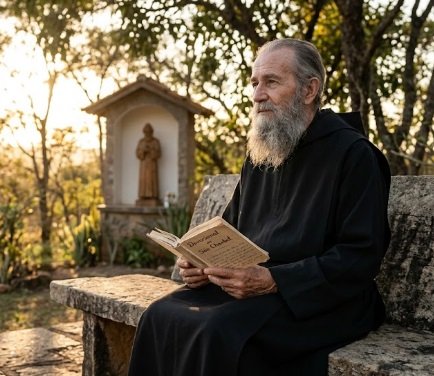
When God Seems Silent
There is another biblical truth that can transform spiritual dryness.
God’s silence does not necessarily mean God’s absence.
Think about Holy Saturday.
Christ had died.
The disciples had experienced the apparent destruction of their hopes.
The tomb was closed.
Everything seemed silent.
But God was working.
The Resurrection had not yet been seen by the disciples.
The silence of the tomb was not the end of the story.
This is why the Catechism connects spiritual dryness with Christ’s agony and tomb before the victory of the Resurrection.
Sometimes we judge God’s work by what we can see.
But faith teaches us to trust God even when His work remains hidden.
The Grain of Wheat
Jesus gives us another profound image:
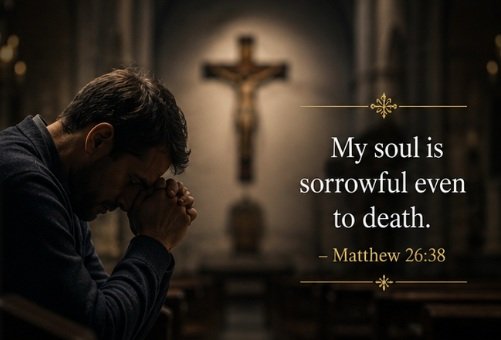
“Unless a grain of wheat falls into the earth and dies, it remains alone; but if it dies, it bears much fruit.”
The Catechism itself uses this passage when explaining spiritual dryness.
Think about the grain.
When it is buried, it appears to disappear.
There is no visible fruit.
No flower.
No harvest.
Nothing seems to be happening.
But beneath the soil, something is happening.
Spiritual life can sometimes be like that.
The absence of visible consolation does not prove the absence of spiritual growth.
However, We Must Also Examine Our Lives
Catholic spirituality must avoid another extreme.
Not every period of dryness should automatically be interpreted as a mystical trial.
Sometimes we need conversion.
The Catechism explicitly teaches that when dryness results from a lack of spiritual roots, the response involves conversion.
Therefore, ask yourself honestly:
- Have I abandoned regular prayer?
- Have I deliberately turned away from God?
- Is there a serious sin I refuse to confront?
- Have distractions completely taken over my life?
- Have I stopped attending Mass?
- Have I allowed resentment to dominate my heart?
- Have I stopped listening to Scripture?
- Have I reduced my faith to occasional religious emotions?
These questions are not meant to produce despair.
They are meant to produce conversion.
The Gospel does not say:
“You failed, therefore stay away.”
It says:
Return.
Spiritual Dryness and the Eucharist
For a Catholic, spiritual life cannot be reduced to private feelings.
The center is Christ.
And Christ gives Himself to the Church in the Eucharist.
The Catechism teaches that contemplative prayer is connected to the mystery of Christ celebrated by the Church in the Eucharist.
Therefore, when you feel spiritually empty, do not make your emotions the measure of the Eucharist.
The reality of Christ’s presence does not depend on whether you feel emotionally moved.
Sometimes you receive Holy Communion with great consolation.
Sometimes you receive it quietly.
Sometimes you feel nothing.
But the Catholic faith rests upon Christ and His promises, not upon the intensity of our emotions.
What Should You Do During Spiritual Dryness?
Here is a simple Catholic path.
1. Keep praying
Even if the prayer is short.
Even if it feels difficult.
Even if you have no consolation.
2. Return to Scripture
Especially the Psalms and the Gospels.
Let God’s Word give you words when your own words disappear.
3. Remain faithful to the sacraments
Do not allow spiritual dryness to isolate you from the life of the Church.
4. Examine your conscience
Ask whether God is calling you to conversion.
5. Reduce unnecessary noise
Turn off the phone.
Leave the screen.
Create moments of silence.
6. Pray the Rosary
Mary teaches the Christian to remain faithful even when she does not understand everything.
7. Spend time before the Eucharistic Lord
You do not always need many words.
Sometimes simply remain with Jesus.
8. Speak with a good priest or spiritual director
If the dryness is prolonged, confusing, or accompanied by serious spiritual discouragement, seek wise pastoral guidance.
9. Do not chase extraordinary experiences
The Catholic spiritual life is not a search for visions, sensations, miracles, or supernatural phenomena.
Seek God Himself.
10. Persevere
This may be the most important point.
Do not abandon prayer simply because prayer has become difficult.
A Prayer for the Catholic Who Feels Nothing
Lord Jesus,
I come before You as I am.
My heart feels dry.
My prayer feels weak.
Sometimes I do not know what to say.
Sometimes I wonder whether You are listening.
But today I choose to remain.
I believe that You are Lord even when I cannot feel Your presence.
I trust Your promises even when I cannot understand Your ways.
Teach me to pray as You prayed in Gethsemane:
“Not my will, but yours, be done.”
Give me perseverance when I am tired.
Give me faith when I am discouraged.
Give me humility when I am confused.
Give me courage to examine my heart and return to You whenever I have wandered.
Teach me the silence of the saints.
Teach me the hidden life of Saint Charbel.
Teach me to seek You not merely for consolation, but because You are God and You are worthy of my love.
Holy Mary, Mother of God, pray for me.
Saint Charbel Makhlouf, pray for me.
Saint Joseph, pray for me.
And above all, Lord Jesus,
do not allow me to abandon You simply because I cannot feel You.
Amen.
If You Pray but Feel Nothing, Remember This
Your faith is not measured by how intensely you feel.
Your prayer is not worthless because you are tired.
Your relationship with God is not defined by one difficult season.
And God’s love does not disappear when your emotions become silent.
The Bible gives us the Psalms.
Christ gives us Gethsemane.
The Church gives us the Sacraments.
The Catechism gives us a language for understanding the battle of prayer.
And the saints give us examples of perseverance.
Saint Charbel gives us a particularly beautiful witness to the power of a hidden life with God.
He lived in silence.
He sought Christ.
He embraced prayer.
He did not need the applause of the world.
And today his witness continues to speak to a world that desperately needs silence.
Perhaps, then, your spiritual dryness is not an invitation to run away from God.
Perhaps it is an invitation to seek Him more deeply.
Not because you feel Him.
But because you trust Him.
Not because prayer is always comforting.
But because Christ remains worthy of your faith.
And perhaps the prayer you whisper today, with no emotion and no consolation—
“Jesus, I am still here.”
—may be one of the most sincere acts of faith you have ever offered Him.
About the Author
Wander Venerio Cardoso de Freitas is a theologian, educator, and author of books on Catholic spirituality, the lives of the saints, and Christian formation. He is the founder of the portal O Senhor Te Dê a Paz (Saints Library), dedicated to evangelization through articles, books, and digital content.
Continue Reading on Our Website
Deepen your devotion and explore more inspiring Catholic resources:
50 Inspiring Saint Charbel Quotes That Will Strengthen Your Faith and Bring You Closer to God
Why Pray the St. Charbel Novena? A Complete Guide to the Spiritual Power of Nine Days of Prayer
10 Timeless Lessons from Saint Charbel That Can Transform Your Relationship with God
Why Do Millions of People Pray to Saint Charbel? The Extraordinary Faith Behind the Miracles
Finding Quiet Strength in Suffering Through Saint Charbel
10 Saint Charbel Quotes on Suffering That Offer Comfort in Hard Times
Powerful Saint Charbel Quotes for Healing and Physical Illness
What Saint Charbel Teaches Us About Redemptive Suffering
Five Days With Saint Charbel: A Free Catholic Devotional for Faith, Hope, and Prayer
Inspiring Saint Charbel Words for Caregivers and Loved Ones
Saint Charbel Quotes to Pray During Times of Bodily Weakness
Saint Charbel Quotes for Chronic Pain Warriors Seeking Hope
Finding Meaning in Pain: Timeless Lessons from Saint Charbel
Saint Charbel on Divine Mercy During Physical Affliction
Saint Charbel Quotes on Bearing Your Daily Cross with Grace
Encouraging Saint Charbel Quotes for Hospital Patients
The Most Inspiring Quotes of Saint Charbel: Words of Faith, Prayer, and Silence
Saint Charbel Quotes When Healing Seems Impossible
Saint Charbel for Catholics Who Are Still Faithful but Secretly Losing Hope