There is a particular kind of loneliness that is difficult to explain.
You can sit inside a Catholic church surrounded by hundreds of people and still feel completely alone.
You attend Mass.
You pray.
You may even volunteer.
Perhaps you have served as a catechist, lector, extraordinary minister, choir member, youth leader, or parish volunteer.
You know many faces.
But sometimes you wonder:
“Does anyone actually know me?”
Perhaps you stopped receiving a phone call.
Nobody asked why you disappeared for a few weeks.
Nobody noticed that you were struggling.
You came to Mass carrying a heavy heart, but you left without speaking to anyone.
And slowly, a painful thought can appear:
“Maybe my parish does not need me.”
For some Catholics, this eventually becomes:
“Maybe the Church does not need me.”
But there is an important distinction.
A parish community can fail to notice someone’s suffering without meaning that Christ has forgotten that person.
And this is where the witness of Saint Charbel Makhlouf can speak with unusual power.
His life was hidden.
He lived in silence and solitude.
Yet his hidden life became a source of consolation for people throughout the world.
In December 2025, Pope Leo XIV visited Saint Charbel’s tomb in Annaya and emphasized that his legacy teaches prayer to those who live without God and silence to those immersed in noise. The Pope also entrusted the Church’s need for communion and unity, including parish communities, to Saint Charbel’s intercession. (Vaticano)
Perhaps that is exactly what some forgotten Catholics need to hear today:
Your parish may not always see you, but Christ sees you.
Deepen Your Faith with the Story of Saint Charbel
If you were moved by this article, discover the complete journey of faith, silence, and supernatural healings in The Life and Miracles of Saint Charbel by Wander Venerio Cardoso de Freitas.
Discover how a humble Lebanese hermit became one of the Catholic Church’s greatest miracle workers.
Explore the documented miracles and official healings recognized by the Church.
Renew your daily prayer life with timeless spiritual lessons.
🛒 [Get Your Paperback / Kindle Copy on Amazon]
When You Feel Invisible at Church
The pain of feeling forgotten by a parish can be especially confusing because the Church is supposed to be a family.
Jesus did not establish Christianity as an isolated relationship between individuals and God.
He gathered disciples.
He formed a community.
He called them to love one another.
At the Last Supper, Christ prayed:
“That they may all be one.”
— John 17:21
And Saint Paul gives an even more intimate image.
He describes the Church as the Body of Christ.
“You are the body of Christ and individually members of it.”
— 1 Corinthians 12:27
This means that Catholic life is inherently communal.
We are not merely people who happen to attend the same building on Sunday.
Through Baptism, we become members of Christ and are incorporated into His Church.
The Catechism teaches that Christ associates His disciples with His own life and mission and that communion with Christ necessarily has an ecclesial dimension. (Vaticano)
Therefore, the desire to be known, welcomed, heard, and loved within a parish is not weakness.
It is profoundly human and deeply Christian.
The Parish Should Be a Place of Belonging
The Church herself recognizes the importance of parish belonging.
The Vatican has described the parish as an ordinary point of contact between Catholics and the Church and emphasized that parish life can provide a place where people experience communion, belonging, and growth as disciples of Christ.
Saint John Paul II also spoke about people living on the margins of parish life who may not have rejected the Church at all, but are waiting for concrete signs of listening, dialogue, and human and spiritual relationship. (Vaticano)
That observation is remarkably relevant.
Some Catholics who disappear from parish life have not stopped believing.
They are simply wounded.
They may be tired.
They may have been overlooked.
They may have experienced rejection.
They may be carrying family problems.
They may be struggling with loneliness.
Or perhaps nobody ever took the time to ask:
“How are you really doing?”
Jesus Notices the Person Others Overlook
The Gospel repeatedly shows us something beautiful about Jesus.
He notices people.
When everyone was concerned about crowds, Jesus noticed individuals.
He saw Zacchaeus in the tree.
He saw Bartimaeus by the roadside.
He noticed the widow who placed two small coins into the treasury.
He stopped for the woman who touched His garment.
He spoke with the Samaritan woman whom others might have avoided.
He called Mary Magdalene by name after the Resurrection.
And Jesus says:
“I know my own and my own know me.”
— John 10:14
This is the heart of Christian hope.
Your identity before God does not depend upon how visible you are to other people.
You may feel forgotten by a parish.
You may feel forgotten by a ministry.
You may feel forgotten by a group of friends.
But you are not forgotten by Christ.
Saint Charbel: The Saint Who Lived Hidden
Saint Charbel offers a remarkable paradox.
He lived much of his life away from public attention.
He did not build a reputation through speeches.
He did not seek recognition.
He did not attempt to become famous.
He embraced a hidden life of prayer, silence, sacrifice, and communion with God.
And yet, after his death, people from many places began seeking his intercession.
Pope Paul VI, who canonized Saint Charbel in 1977, reflected on this extraordinary mystery: although the saint had lived as a solitary monk and hermit, people from different countries came to his tomb, sought his intercession, and many returned to the sacramental life of the Church. (Vaticano)
His life teaches something beautiful:
Being hidden from the world does not mean being forgotten by God.
Sometimes God does His deepest work in places nobody sees.
You Do Not Need to Be Popular to Be Valuable
Our culture constantly teaches us to measure value through visibility.
Followers.
Likes.
Invitations.
Recognition.
Positions.
Influence.
Even inside religious communities, it can sometimes appear that the most visible people are the most important.
But the Gospel tells another story.
Jesus says:
“Your Father who sees in secret will reward you.”
— Matthew 6:4
The Christian life is not a competition for visibility.
God sees what other people cannot see.
He sees the person who arrives early to open the church.
He sees the mother who quietly teaches her children to pray.
He sees the elderly Catholic who attends Mass despite physical limitations.
He sees the catechist who prepares lessons nobody thanks them for.
He sees the person who sits alone in the last pew.
He sees the person who comes to confession after years away.
He sees the person who prays for the parish without anyone knowing.
Nothing offered to God in love is invisible to Him.
What If Your Parish Really Has Forgotten You?
We should not spiritualize everything.
Sometimes a person really has been neglected.
Sometimes pastoral structures fail.
Sometimes communities become closed circles.
Sometimes ministries become more concerned with internal relationships than with welcoming those who are outside.
Sometimes people unintentionally create groups that make newcomers feel like outsiders.
The Church herself has repeatedly called parishes toward greater communion, welcome, listening, and pastoral care. Pope Leo XIV recently highlighted the need for parishes to strengthen belonging and welcome everyone with open arms. (Vaticano)
So if you have been hurt, you do not have to pretend that nothing happened.
Your pain deserves to be taken seriously.
But there is also a danger:
Do not allow the failure of a human community to become the measure of God’s love.
A parish can fail you.
A ministry can disappoint you.
A Catholic friend can hurt you.
A priest can misunderstand you.
But Christ remains Christ.
“I Feel Like Nobody Needs Me”
This is one of the most dangerous thoughts that can enter a wounded Catholic heart.
“I am not useful.”
“I am too old.”
“I am too young.”
“I have nothing to offer.”
“Other people are more talented.”
“They already have enough volunteers.”
“I don’t belong here.”
But Saint Paul destroys this way of thinking when he explains the Body of Christ.
“The eye cannot say to the hand, ‘I have no need of you.’”
— 1 Corinthians 12:21
Every member has a place.
Every vocation has dignity.
Every baptized Christian is called to holiness.
The Catechism teaches that Baptism and Confirmation ground the common vocation of all Christ’s disciples to holiness and mission. (Vaticano)
You do not need a title to have a vocation.
You do not need a microphone to have a mission.
You do not need to stand on a stage to serve Christ.
Sometimes your mission is simply to love the person sitting next to you.
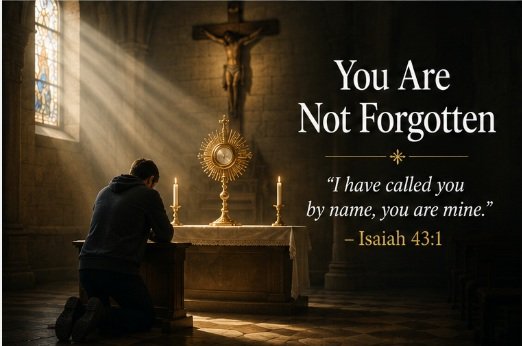
The Eucharist Reminds You That You Belong
When you feel forgotten by your parish, return to the center.
Not the parish group.
Not the ministry.
Not the committee.
Not the social circle.
Christ.
The Catechism calls the Eucharist the “source and summit of the Christian life” and teaches that the Eucharist is the sign and cause of communion in the divine life and unity of God’s people. (Vaticano)
This changes the way we understand Sunday Mass.
You are not attending merely to see people.
You are not attending because someone remembers your name.
You are going because Christ is there.
You belong to Him.
And in the Eucharist, the Church gathers as one Body.
Even when nobody speaks to you.
Even when nobody knows your story.
Even when you feel invisible.
You are still standing before the Lord who knows you completely.
Saint Charbel and the Power of the Hidden Life
Saint Charbel’s life is especially beautiful for Catholics who feel overlooked.
Why?
Because he knew what it meant to live without recognition.
His holiness was not built upon applause.
His spiritual life was not dependent upon being noticed.
He lived before God.
That is a lesson our age desperately needs.
Pope Leo XIV described Saint Charbel as a man who lived hidden and silent, yet whose spiritual influence spread throughout the world. He also presented his steadfastness as a message for all Christians, not merely for monks or religious people. (Vaticano)
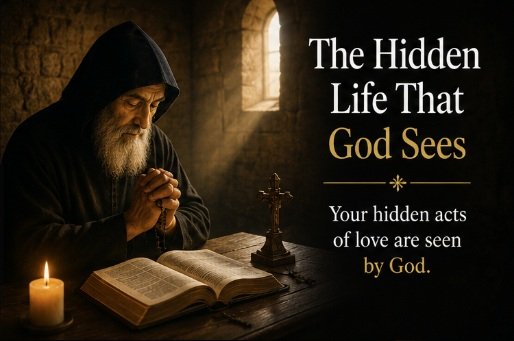
Your hidden acts of love may be more important than you realize.
The prayer nobody hears.
The sacrifice nobody knows about.
The forgiveness nobody applauds.
The Mass you attend while carrying a heavy heart.
The rosary you pray for your family.
The kindness you offer to someone who cannot repay you.
God sees all of it.
What Should You Do When You Feel Forgotten?
If you are experiencing this pain, don’t make an impulsive decision to abandon the Church.
Instead, take several steps.
1. Bring the Pain to Jesus
Don’t hide your feelings from God.
Pray honestly.
Say:
“Lord, I feel forgotten.”
The Psalms are full of this kind of honest prayer.
God is not frightened by your wounds.
2. Ask God for One Person
You don’t necessarily need to become part of the biggest parish group.
Ask God to place one trustworthy Catholic person in your path.
One person who can listen.
One person with whom you can pray.
One person who can walk with you.
Sometimes one genuine friendship can become the beginning of healing.
3. Take One Small Step Toward Community
Do not wait for everyone to discover you.
Introduce yourself.
Speak to another parishioner.
Join a Bible study.
Attend a prayer group.
Volunteer in a simple ministry.
Invite someone for coffee.
Small acts of communion can reopen doors that seemed closed.
4. Don’t Chase Recognition
This is where Saint Charbel can help.
Serve God even when nobody applauds.
Jesus teaches:
“When you give alms, do not let your left hand know what your right hand is doing.”
— Matthew 6:3
The hidden life is not an inferior life.
It can be a very pure offering to God.
What If You Were Hurt by Catholics?
This deserves special attention.
Sometimes the deepest wounds are not caused by strangers.
They come from people who share our faith.
A Catholic can be hurt by another Catholic.
A parishioner can be excluded.
A volunteer can be humiliated.
A family can be ignored.
A young person can feel judged.
A returning Catholic can feel unwelcome.
And the temptation is understandable:
“If this is how Catholics behave, I don’t want anything to do with the Church.”
But Christianity cannot ultimately be reduced to the behavior of imperfect Christians.
Look at Peter.
He denied Christ.
Look at Thomas.
He doubted.
Look at the disciples.
They argued.
The Church has always been made up of sinners who are being transformed by grace.
The answer to human failure is not to pretend it does not exist.
The answer is conversion.
A Parish Is More Than a Building
The word parish can easily become associated with a building, schedule, office, or organization.
But the Catholic vision is much richer.
The parish is meant to be a place where believers encounter Christ, receive the sacraments, grow in faith, and live communion.
The Eucharist is the source and summit of ecclesial life, and the Church exists as a communion in Christ. (Vaticano)
That means every Catholic has a responsibility.
If you feel forgotten, perhaps God is also inviting you to notice someone else.
Look around Mass.
Who is sitting alone?
Who is new?
Who arrived late and seems uncomfortable?
Who is elderly?
Who is carrying a child?
Who looks sad?
Who stopped attending?
Who needs someone to say:
“It is good to see you.”
Perhaps the healing of your own loneliness will begin when you help another person feel less alone.
Saint Charbel’s Lesson: Belong First to Christ
This may be the deepest lesson.
Before belonging to a parish group, you belong to Christ.
Before belonging to a ministry, you belong to Christ.
Before receiving recognition from other Catholics, you belong to Christ.
Before anyone knows your name, Christ knows your name.
Jesus says:
“I have called you by name, you are mine.”
— Isaiah 43:1
This is the foundation.
Your parish membership is important.
Christian community is important.
Pastoral care is important.
But your ultimate identity does not come from being noticed by people.
It comes from belonging to God.
Lord Jesus,
A Prayer for Catholics Who Feel Forgotten
I come before You carrying something I find difficult to explain.
I feel forgotten.
I feel invisible.
Sometimes I wonder whether anyone in my parish notices me.
Sometimes I wonder whether I still have a place in the Church.
But today I choose to look beyond my feelings and look toward You.
You know me.
You see me.
You know my wounds, my disappointments, my sacrifices, and the things I have never been able to tell anyone.
Give me the grace not to confuse human weakness with Your love.
If I have been wounded, heal me.
If I have withdrawn, give me courage to return.
If I have become bitter, soften my heart.
If I have been overlooked, remind me that You never overlook me.
Teach me, through the example of Saint Charbel, to live before You even when nobody sees me.
Teach me to serve without demanding recognition.
Teach me to forgive without denying the truth.
Teach me to remain faithful without depending upon human applause.
And if there is someone else in my parish who feels forgotten, give me the eyes to see them.
Make me an instrument of welcome.
Make me an instrument of communion.
Make me an instrument of Your love.
Saint Charbel Makhlouf, pray for me.
Holy Mary, Mother of the Church, pray for me.
Saint Joseph, guardian of the Church, pray for me.
Lord Jesus, help me remember:
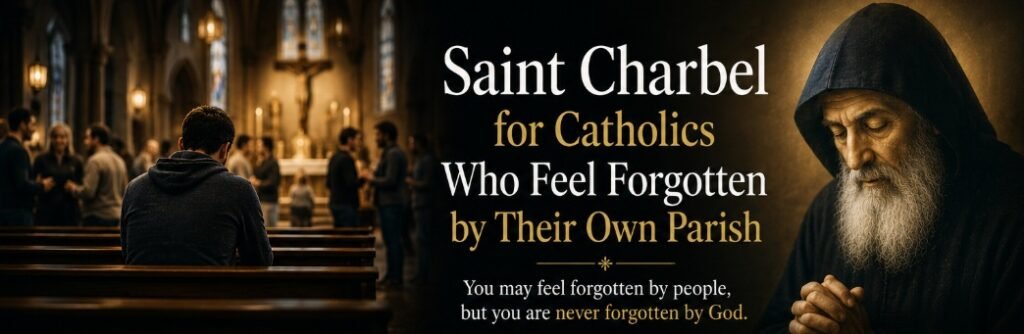
I may be forgotten by people, but I am never forgotten by You.
Amen.

You Are Not Forgotten
Perhaps you came to this article because something happened in your parish.
Perhaps nobody called.
Perhaps nobody noticed.
Perhaps you served for years and suddenly felt invisible.
Perhaps you are new and don’t know where you belong.
Perhaps you returned to the Church after many years and expected to feel at home, but instead felt like a stranger.
If that is your story, do not give up on Christ because of a painful experience with people.
Bring your wound to Him.
The Gospel tells us that Jesus is the Good Shepherd who knows His sheep.
And the Church teaches that Christian life is fundamentally a communion with Christ and with His Body. (Vaticano)
Saint Charbel gives us another beautiful lesson.
He lived hidden.
He lived in silence.
He was not seeking the world’s attention.
Yet God transformed his hidden life into a source of grace and consolation for countless people.
So perhaps your hiddenness is not useless.
Perhaps your quiet faith matters.
Perhaps your perseverance matters.
Perhaps the prayers nobody hears are precious before God.
And perhaps the next time you enter your parish church and feel that nobody notices you, remember this:
You are not entering an empty room.
You are entering the house where Christ gathers His people.
And even if no one says your name,
Christ knows it.
Even if nobody notices your tears,
Christ sees them.
Even if nobody understands your pain,
Christ understands it.
And even if you feel forgotten by your own parish,
you have never been forgotten by God.
📚 This article is part of the Ultimate Guide to St. Charbel
If you want to discover the complete story of St. Charbel Makhlouf—from his childhood, religious vocation, and monastic life to the miracles recognized by the Church, the mystery of his incorrupt body, his prayers, the novena, his powerful intercession, and his extraordinary path to holiness—be sure to visit our Ultimate Guide to St. Charbel, the most comprehensive resource on our website about this beloved Maronite saint.
About the Author
Wander Venerio Cardoso de Freitas is a theologian, educator, and author of books on Catholic spirituality, the lives of the saints, and Christian formation. He is the founder of the portal O Senhor Te Dê a Paz (Saints Library), dedicated to evangelization through articles, books, and digital content.