
There was a time when many Catholic families prayed together at home.
A Rosary after dinner.
A short prayer before going to bed.
A blessing before a journey.
A Bible passage read at the table.
A simple prayer before meals.
Today, many Catholic families still love God, attend Mass, and believe in the Catholic faith, but something has quietly disappeared from their homes.
Family prayer.
The problem often does not happen suddenly.
Life becomes busy.
Children grow older.
Parents become exhausted.
Work takes more time.
Phones remain in everyone’s hands.
Television and streaming replace conversation.
Social media fills moments that once belonged to silence.
And one day, a Catholic parent realizes:
“We used to pray together. Now we hardly ever do.”
Perhaps you have experienced this.
Perhaps your family still believes in God, but prayer has become something each person does privately, occasionally, or not at all.
If this is happening in your home, do not begin with guilt.
Begin with hope.
The Christian family is called to become a place where faith is lived, transmitted, and nourished.
And the life of Saint Charbel offers a profound invitation to rediscover something our noisy age desperately needs:
silence before God.

Why Family Prayer Matters in Catholic Life
The family has a unique place in Catholic teaching.
The Catechism calls the Christian family a domestic church, or ecclesia domestica. Through the sacrament of Matrimony, parents receive the grace and responsibility of being the first heralds of the faith for their children. (vatican.va)
This means that the transmission of Catholic faith does not begin only in the parish classroom.
It begins at home.
Children learn how to pray by watching their parents pray.
They learn that God is important when they see their parents stop what they are doing to speak with Him.
They learn gratitude when the family gives thanks before a meal.
They learn trust when parents pray during difficult circumstances.
They learn forgiveness when the family asks God for mercy.
They learn that faith is not merely something practiced inside a church building.
Faith becomes part of everyday life.

Deepen Your Faith with the Story of Saint Charbel
If you were moved by this article, discover the complete journey of faith, silence, and supernatural healings in The Life and Miracles of Saint Charbel by Wander Venerio Cardoso de Freitas.
Discover how a humble Lebanese hermit became one of the Catholic Church’s greatest miracle workers.
Explore the documented miracles and official healings recognized by the Church.
Renew your daily prayer life with timeless spiritual lessons.
🛒 [Get Your Paperback / Kindle Copy on Amazon]
The Bible Gives the Family a Mission
The Old Testament already presents the transmission of faith within the family as a sacred responsibility.
Moses says:
“And you shall teach them diligently to your children.”
Deuteronomy 6:7
The context is beautiful.
The Word of God is not supposed to remain confined to a religious setting.
It belongs in the ordinary rhythm of family life.
At home.
At the table.
Along the road.
When waking.
Before sleeping.
The family becomes one of the first places where a child discovers that God is not distant from everyday life.
This is why the disappearance of family prayer matters.
When prayer disappears completely from the home, children can begin to receive an unintended message:
God belongs to church, but not necessarily to our daily lives.
Catholic family prayer helps communicate the opposite.
God belongs everywhere because every part of our lives belongs to Him.
Jesus Himself Prayed With His Family and People
The Gospels repeatedly show Jesus praying.
He prayed before important moments.
He withdrew to quiet places.
He prayed before His Passion.
He taught His disciples how to pray.
He taught them the Our Father.
And He promised:
“For where two or three are gathered in my name, there am I among them.”
Matthew 18:20
This verse has a special beauty when applied to family life.
A husband and wife praying together are not merely performing a religious activity.
Parents praying with their children are creating a small place of encounter with God.
A family gathered around a crucifix can become a school of faith.
A home can become a place where children learn that silence is not empty.
Silence can be filled with God.
What Happens When the Home Becomes Too Noisy?
Modern families face a problem previous generations did not experience at the same scale.
Constant digital stimulation.
A child can wake up and immediately reach for a phone.
A parent can eat dinner while answering messages.
A teenager can spend hours watching short videos.
A family can sit in the same room while everyone is looking at a different screen.
There may be plenty of communication, but very little conversation.
There may be plenty of sound, but very little silence.
There may be plenty of information, but very little reflection.
This is why the spirituality of Saint Charbel can speak so powerfully to families today.

Saint Charbel and the Return to Silence
Saint Charbel Makhlouf lived a radically hidden life of prayer, solitude, sacrifice, and devotion to God.
He was born Youssef Makhlouf in Lebanon and became a monk and priest of the Lebanese Maronite Order. Later, he lived as a hermit at the Hermitage of Saints Peter and Paul near Annaya.
His life was not built around noise.
It was built around prayer.
It was not centered on recognition.
It was centered on God.
Pope Paul VI emphasized Saint Charbel’s profound life of prayer, Eucharistic devotion, solitude, and sacrifice when he canonized him in 1977. (vatican.va)
Saint Charbel was not a husband or father.
Therefore, we should not present him as a model of family life in the same way as a married saint.
His relevance is different.
He teaches the family something essential about the interior life.
He reminds us that God does not need noise to transform a person.
And a Catholic family does not need an elaborate spiritual program to begin praying again.
Sometimes it needs only a few minutes of sincere silence.
Your Family Does Not Need Perfect Prayer
One of the reasons family prayer disappears is that parents think they need to create something elaborate.
They imagine that family prayer must last thirty minutes.
Everyone must sit perfectly still.
The children must behave.
Someone must read Scripture beautifully.
Everyone must know all the prayers.
Then reality arrives.
The baby cries.
The teenager complains.
Someone is hungry.
Someone is tired.
Someone starts laughing.
And the family gives up.
But Catholic family prayer does not have to be perfect.
It needs to be faithful.
Five minutes of sincere prayer can be better than an ambitious routine that lasts three days.
Start small.
Pray one Our Father.
Say one Hail Mary.
Thank God for the day.
Read three verses from the Gospel.
Ask forgiveness.
Pray for someone who is suffering.
Then stop.
Tomorrow, do it again.
The Family Rosary Can Begin With One Decade
Many Catholic families are intimidated by the idea of praying an entire Rosary together.
But there is another way to begin.
Pray one decade.
Gather the family.
Light a candle if appropriate.
Place a crucifix or image of the Holy Family nearby.
Announce one mystery.
Pray slowly.
Then finish.
Perhaps after several weeks the family will naturally want to pray more.
The important thing is not to turn family prayer into a burden.
The goal is to help the family rediscover the joy of being together before God.
📚 This article is part of the Ultimate Guide to St. Charbel
If you want to discover the complete story of St. Charbel Makhlouf—from his childhood, religious vocation, and monastic life to the miracles recognized by the Church, the mystery of his incorrupt body, his prayers, the novena, his powerful intercession, and his extraordinary path to holiness—be sure to visit our Ultimate Guide to St. Charbel, the most comprehensive resource on our website about this beloved Maronite saint.
When Children Do Not Want to Pray
This is one of the most difficult situations for Catholic parents.
A teenager may say:
“I don’t want to pray.”
A child may become distracted.
Another may laugh.
Parents can become frustrated.
But remember something important.
You are forming a person, not merely completing a religious task.
Do not make every prayer experience a battle.
Instead, create a gentle rhythm.
Pray before meals.
Bless your children before bedtime.
Say a short prayer when someone is sick.
Pray together when someone has an important exam.
Thank God when something good happens.
Ask God for help when something difficult happens.
Little by little, children discover that prayer belongs to real life.
The Family Can Learn From the Holy Family
The Holy Family of Nazareth gives Catholics a beautiful image of ordinary holiness.
Jesus, Mary, and Joseph lived an ordinary family life.
There was work.
There was responsibility.
There was obedience.
There were journeys.
There were moments of uncertainty.
There was suffering.
And there was the presence of God.
The Catechism teaches that the hidden life of Jesus at Nazareth allows us to understand the sanctification of ordinary family life and daily work. (vatican.va)
This is important.
You do not need to escape ordinary life to become holy.
You can become holy in your kitchen.
At your dinner table.
While putting your children to bed.
During a family meal.
In the car.
In the moments when everyone is tired.
The family home itself can become a place where God is remembered.
What If Your Family Has Completely Stopped Praying?
Then begin again.
Do not wait for a special occasion.
Do not wait for Advent.
Do not wait for Lent.
Do not wait for the children to become more mature.
Do not wait until everyone is enthusiastic.
Choose one simple moment.
Tonight.
Perhaps after dinner.
Turn off the television.
Put the phones away for five minutes.
Gather everyone.
And say:
“Let us pray together.”
If nobody knows what to say, pray the Our Father.
Then say:
“Thank You, Lord, for our family. Help us remain close to You and to one another.”
That may be enough.
Tomorrow, repeat it.
The Father Has an Important Role
Catholic family prayer does not belong exclusively to mothers.
Fathers have a profound responsibility in the spiritual life of their families.
A father who kneels with his children teaches something without giving a lecture.
He teaches:
God comes first.
A father who blesses his child before bedtime teaches:
You are loved by God.
A father who asks forgiveness teaches:
Humility is strength.
A father who prays when the family is suffering teaches:
We do not face difficulties alone.
This is evangelization within the home.
Mothers Also Shape the Spiritual Atmosphere of the Home
The same is true of mothers.
A mother who teaches her children to pray the Hail Mary.
A mother who keeps a crucifix in the home.
A mother who remembers the saints.
A mother who prays for her children.
A mother who brings faith into ordinary conversations.
These things can remain in a child’s memory for decades.
The family becomes a living catechism.
Not a perfect catechism.
A lived one.
When Family Members Have Different Levels of Faith
Sometimes one spouse is more religious than the other.
Sometimes one child is deeply interested in Catholicism while another is indifferent.
Sometimes grandparents are practicing Catholics while their grandchildren rarely pray.
Do not respond with constant pressure.
Witness matters.
Charity matters.
Patience matters.
Pray.
Invite.
Encourage.
But avoid turning prayer into a weapon.
The goal is not to force an emotional religious experience.
The goal is to create an environment in which the family can encounter Christ.
Saint Charbel Teaches Us That Silence Can Restore the Soul
Perhaps the greatest lesson Saint Charbel offers modern families is simple:
Recover silence.
Turn off the television.
Put down the phone.
Stop scrolling.
Sit together.
Pray.
Listen.
Remain.
The Catechism describes contemplative prayer as attentive silence before God and teaches that this silence is not simply the absence of words. It is an attentive openness to God. (vatican.va)
A family that learns to be silent together can begin to discover something that modern culture often forgets:
We do not always need entertainment to be happy.
Sometimes we need presence.
Presence with one another.
And ultimately, presence before God.
A Simple Seven Minute Catholic Family Prayer
If your family has lost the habit of praying together, try this simple routine.
Minute 1: Make the Sign of the Cross.
Minute 2: Thank God for one thing.
Minute 3: Read a short passage from the Gospel.
Minute 4: Remain silent for a moment.
Minute 5: Pray one Our Father and one Hail Mary.
Minute 6: Each person may mention one prayer intention.
Minute 7: End with a simple prayer of thanksgiving.
That is enough to begin.
Do not underestimate small beginnings.
A family prayer routine does not have to be impressive.
It needs to become part of the rhythm of the home.
What If Someone Refuses to Participate?
Remain peaceful.
Do not turn prayer into a source of family conflict.
Those who want to participate can pray.
Those who do not may simply remain nearby.
Continue your witness.
Continue inviting.
Continue loving.
And pray privately for the family member.
God works patiently.
Parents cannot convert their children’s hearts by force.
But they can create an environment where faith is visible, beautiful, and sincere.
Family Prayer During Difficult Times
One of the most powerful moments to restore family prayer is precisely when life becomes difficult.
When someone is sick.
When a marriage is struggling.
When finances are difficult.
When a child is suffering.
When someone loses employment.
When a family member dies.
When the future is uncertain.
These are moments when prayer becomes more than a religious habit.
It becomes an act of trust.
The Psalms teach us that God’s people can bring suffering directly to Him.
Jesus Himself taught His disciples to ask the Father for daily bread and forgiveness.
Prayer teaches the family:
We do not control everything, but we know where to turn.
A Family That Prays Together Learns to Forgive
Family prayer is not only about asking God for blessings.
It also teaches forgiveness.
The Our Father contains a profound request:
“Forgive us our trespasses, as we forgive those who trespass against us.”
Matthew 6:12
Imagine a family that prays these words together every day.
The children hear them.
The parents hear them.
Everyone is reminded that Christian family life requires forgiveness.
Not because offenses are unimportant.
But because mercy is essential to Christian life.

A Prayer to Restore Family Prayer
Lord Jesus,
Come into our home.
We have become distracted.
We have become busy.
Sometimes we have forgotten to pray together.
Forgive us.
Teach our family to return to You.
Give parents wisdom.
Give children open hearts.
Give husbands and wives patience.
Give our home the grace of peace.
Teach us to put aside our phones and distractions.
Teach us to listen.
Teach us to remain silent before You.
Teach us to pray when life is beautiful and when life is difficult.
May our home become a place where Your name is remembered.
May our children learn from us that You are not only the God we worship at church.
You are the Lord of our entire lives.
Through the intercession of Saint Charbel, teach us the value of silence, prayer, sacrifice, and hidden holiness.
Holy Family of Nazareth, pray for our family.
Saint Joseph, protect our home.
Mary, Mother of the Church, lead us closer to your Son.
Saint Charbel Makhlouf, pray for us.
Amen.
Your Family Can Begin Again Tonight
Maybe your family has not prayed together for months.
Maybe it has been years.
Maybe your children are already teenagers.
Maybe everyone is busy.
Maybe the house is noisy.
Maybe you feel embarrassed because you don’t know how to begin.
Begin anyway.
Do not wait for perfection.
Do not wait for everyone to become spiritually enthusiastic.
Do not wait for the perfect moment.
Gather the family.
Turn off the screens.
Make the Sign of the Cross.
Say one prayer.
Then tomorrow, pray again.
Saint Charbel’s life reminds us that great spiritual fruit can grow from a life hidden from the world’s attention.
The same principle can apply to the family.
A small prayer at the dinner table may seem insignificant.
A mother teaching her child the Hail Mary may seem ordinary.
A father kneeling beside his children may seem simple.
A family praying together for seven minutes may seem almost too small to matter.
But God sees what happens in secret.
And sometimes the seeds planted in a quiet home take years before their fruit becomes visible.
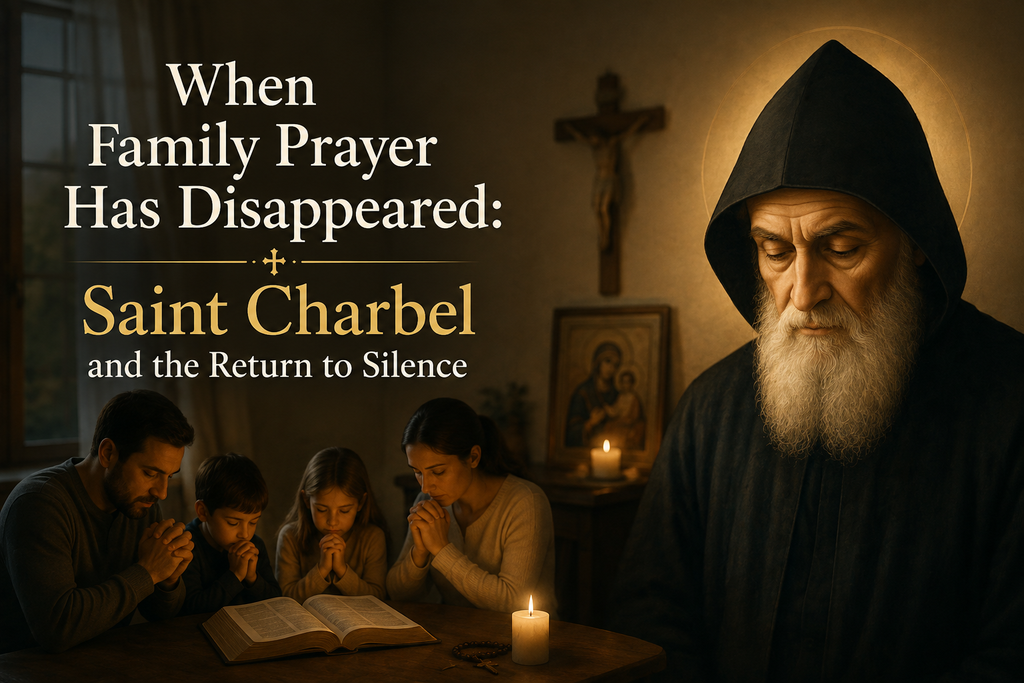
The Silence You Recover Today May Bless Your Children Tomorrow
A child may forget many things.
But they may remember the sound of their mother’s voice praying.
They may remember their father’s hands folded in prayer.
They may remember the family kneeling before a crucifix.
They may remember the Rosary.
They may remember that when someone was sick, the family prayed.
They may remember that when something wonderful happened, the family gave thanks.
They may remember that Sunday was different.
They may remember that God was part of the home.
This is one of the most beautiful forms of Catholic evangelization.
Not merely explaining the faith.
Living it.
The family does not need to become a monastery.
But it can recover a little of the silence that Saint Charbel embraced.
It can recover the habit of stopping.
Listening.
Praying.
And remembering God.
Final Reflection
If family prayer has disappeared from your home, do not interpret that as the end.
It may simply be time to begin again.
The Catholic Church calls the family a domestic church.
Scripture calls parents to transmit faith to their children.
Jesus teaches His disciples to pray.
The Eucharist gathers the Church into communion.
And the saints show us that prayer can transform even the most hidden moments of life.
Saint Charbel lived a life of profound silence.
He sought God away from the noise of the world.
Today, families face a different kind of desert.
Not necessarily a physical desert.
A digital one.
A desert of constant noise.
Constant notifications.
Constant entertainment.
Constant distraction.
Perhaps the answer is not to escape the modern world completely.
Perhaps it is to recover small spaces in which God can once again be heard.
Tonight, gather your family.
Put away the phones.
Turn off the television.
Light a candle.
Open the Gospel.
Pray.
Even if it lasts only five minutes.
Even if the children are distracted.
Even if the prayer feels imperfect.
Begin.
Because a family does not become a domestic church through perfection.
It becomes one through faithfulness.
And perhaps one day, years from now, your children will remember that there was a moment when your family rediscovered silence.
A moment when everyone stopped.
A moment when the house became quiet.
A moment when someone said:
“Let us pray.”
And perhaps that simple sentence will remain in their hearts for the rest of their lives.
Saint Charbel, teach our families to rediscover the silence in which the heart learns to listen to God.
About the Author
Wander Venerio Cardoso de Freitas is a theologian, educator, and author of books on Catholic spirituality, the lives of the saints, and Christian formation. He is the founder of the portal O Senhor Te Dê a Paz (Saints Library), dedicated to evangelization through articles, books, and digital content.