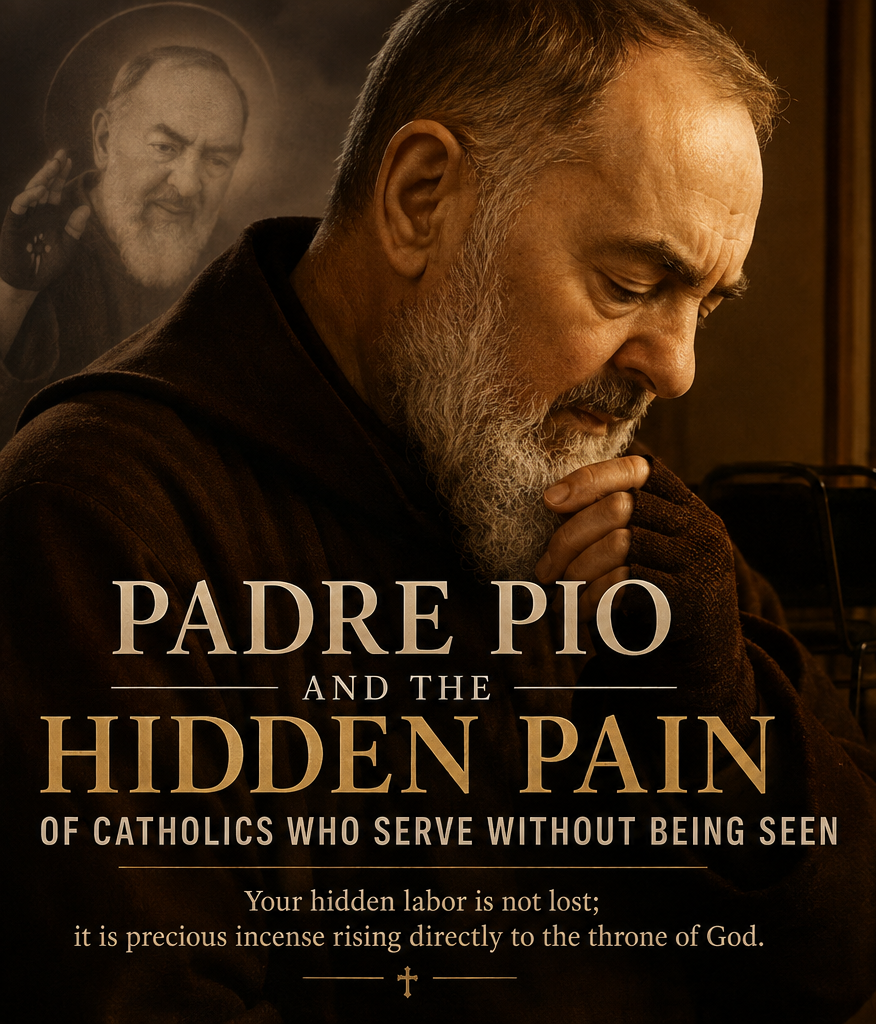
When life falls apart—whether through financial ruin, sudden heartbreak, terminal illness, or severe anxiety—the weight of despair can feel intolerable. In those dark moments, ordinary words offer little comfort, and the soul cries out for real spiritual relief. Saint Padre Pio of Pietrelcina (1887–1968) understood this unbearable weight better than most. Carrying the holy stigmata of Christ for fifty years while enduring physical torment and spiritual attacks, he became a living witness to how divine mercy transforms human anguish into a channel of redemption.
The cross you carry today is not an engine of destruction, but an invitation to divine union.
Padre Pio did not offer vague, sugar-coated platitudes to those who came to him in distress. Instead, he handed them a practical, supernatural toolset deeply rooted in Sacred Scripture and Catholic Church doctrine. Grounded in the deposit of faith (depositum fidei), this guide reveals how to transform your current hardship into a wellspring of relief, spiritual strength, and miraculous grace.
Table of Contents
- The Biblical Roots of Human Suffering
- Catholic Church Doctrine on Pain and Grace
- Padre Pio’s 3 Pillars for Surviving Any Crisis
- 4 Steps to Find Immediate Relief Today
- Padre Pio’s Efficacious Novena to the Sacred Heart of Jesus
- Frequently Asked Questions
- Final Reflection
The Biblical Roots of Human Suffering
Sacred Scripture reveals that suffering is neither a random accident of history nor a sign that God has abandoned His children. From Genesis to Revelation, trials serve as a divine crucible to test, refine, and elevate the soul:
- The Refining Fire of Trials: The Old Testament reveals that God allows adversity to purify pure faith from worldly attachments: “For you, O God, have tested us; you have tried us as silver is tried” (Psalm 66:10). The Apostle Peter echoes this truth: “so that the tested genuineness of your faith… may be found to result in praise and glory and honor at the revelation of Jesus Christ” (1 Peter 1:7).
- Completing Christ’s Afflictions: Saint Paul unveils the mystical architecture of pain in his letter to the Colossians: “Now I rejoice in my sufferings for your sake, and in my flesh I am filling up what is lacking in Christ’s afflictions for the sake of his body, that is, the church” (Colossians 1:24). Human suffering gains infinite spiritual currency when merged with Christ’s unique sacrifice on Calvary.
- The Promise of Divine Proximity: God does not watch our struggles from a cold distance. The Psalmist assures us: “The Lord is near to the brokenhearted and saves the crushed in spirit” (Psalm 34:18).
- The Eternal Weight of Glory: The Apostle Paul reminds struggling believers that earthly affliction is temporary compared to the reward of eternal life: “For this light momentary affliction is preparing for us an eternal weight of glory beyond all comparison” (2 Corinthians 4:17).
Catholic Church Doctrine on Pain and Grace
The Catholic Church provides clear dogmatic teaching on how the faithful ought to view suffering, divine providence, and the sacraments:
- Redemptive Suffering (CCC 1505): The Catechism of the Catholic Church explains: “By his passion and death on the cross Christ has given a new meaning to suffering: it can henceforth configure us to him and unite us with his redemptive Passion.” Suffering endured in union with Christ is never wasted; it actively assists in the conversion of sinners and the sanctification of the Mystical Body.
- Divine Providence and the Permission of Evil (CCC 311–312): Catholic doctrine teaches that God is in no way, directly or indirectly, the cause of moral evil. However, in His almighty power and wisdom, God permits physical and moral evil because He “knows how to derive good from it.” As Saint Augustine noted, God would not permit evil unless He were powerful enough to bring forth a greater good from it.
- The Sacramental Remedy (CCC 1520): The Church provides the Sacrament of the Anointing of the Sick to grant the suffering believer special grace, interior peace, strength to resist despair, and the forgiveness of sins if the person is unable to receive Reconciliation.
- The Communion of Saints and Intercession (CCC 2635): Intercessory prayer is a sharing in Christ’s intercession. Asking Saints like Padre Pio to present our heartbreaks before the throne of God reflects the organic unity of the Church Militant on earth and the Church Triumphant in Heaven.
Padre Pio’s 3 Pillars for Surviving Any Crisis
Padre Pio offered thousands of suffering penitents a direct spiritual strategy to navigate their darkest hours:
1. “Pray, Hope, and Don’t Worry”
Anxiety disrupts the soul’s ability to hear God’s guidance. Padre Pio reminded believers that worrying is completely useless because Divine Providence holds ultimate control over every detail of our lives. As Christ Himself warned: “Which of you by being anxious can add a single hour to his span of life?” (Matthew 6:27).
2. Live in the Present Moment
Padre Pio urged: “The past is in God’s mercy; the future is in His providence. Only the present is ours.” Sanctifying grace is given exclusively for the current day. Focus on surviving and praying now, leaving tomorrow’s burdens to God.
3. Abandon Self-Will to the Divine Will
Human logic cannot fathom why God permits specific heartbreaks. Surrendering the intellectual demand to “figure it all out” and praying like Jesus in Gethsemane—“Not my will, but yours, be done” (Luke 22:42)—opens the door to profound interior peace.
4 Steps to Find Immediate Relief Today
If you are currently facing a situation that feels completely hopeless, take these four practical actions grounded in Catholic tradition:
1. Make an Act of Total Surrender (Oblation)
Stop relying on your limited strength. Kneel before a crucifix and pray: “Lord Jesus, I surrender this crisis entirely into Your hands. Take control of my family, my health, and my future.”
2. Recite the Holy Rosary Daily
Padre Pio called the Rosary his “weapon.” The Church teaches that meditating on the Joyful, Luminous, Sorrowful, and Glorious Mysteries allows us to contemplate the Savior through the pure eyes of the Virgin Mary (CCC 2708).
3. Unify Your Trial with the Holy Sacrifice of the Mass
During the Offertory at Holy Mass, spiritually place your heartbreak, physical illness, or anxiety upon the paten along with the host. Allow your personal cross to be consecrated and offered to the Father in union with Christ’s Body and Blood.
4. Seek Solace in Silent Adoration
Spend time in quiet prayer before Jesus in the Blessed Sacrament. Physical silence in the Eucharistic Presence calms the nervous system and dismantles demonic spiritual attacks faster than any human remedy.
Padre Pio’s Efficacious Novena to the Sacred Heart of Jesus
This is the exact prayer Padre Pio recited every single day for all those who requested his intercession:
I. O my Jesus, You have said: “Truly I say to you, ask and you will receive, seek and you will find, knock and it will be opened to you.” Behold I knock, I seek and ask for the grace of… [mention your intention].
Our Father, Hail Mary, Glory Be. Sacred Heart of Jesus, I place all my trust in You.
II. O my Jesus, You have said: “Truly I say to you, if you ask anything of the Father in my name, He will give it to you.” Behold, in Your name, I ask the Father for the grace of… [mention your intention].
Our Father, Hail Mary, Glory Be. Sacred Heart of Jesus, I place all my trust in You.
III. O my Jesus, You have said: “Truly I say to you, heaven and earth will pass away but my words will not pass away.” Encouraged by Your infallible words I now ask for the grace of… [mention your intention].
Our Father, Hail Mary, Glory Be. Sacred Heart of Jesus, I place all my trust in You.
Concluding Prayer:
O Sacred Heart of Jesus, for whom it is impossible not to have compassion on the afflicted, have pity on us miserable sinners, and grant us the grace which we ask of You, through the Sorrowful and Immaculate Heart of Mary, Your tender Mother and ours.
Hail, Holy Queen…
Saint Joseph, foster father of Jesus, pray for us.
Frequently Asked Questions
Is suffering a punishment for my personal sins?
Not necessarily. While sin carries natural destructive consequences, Jesus explicitly corrected the idea that all suffering is direct punishment. In John 9:3, regarding the man born blind, Jesus declared: “It was not that this man sinned, or his parents, but that the works of God might be displayed in him.”
What if I am too exhausted to speak long prayers?
God looks at the heart, not word count. Whispering the Holy Name of Jesus (“Jesus, Son of David, have mercy on me”) or making a simple act of trust while holding a Rosary carries immense weight in the eyes of God.
How can Padre Pio help me today from Heaven?
The Catholic Church teaches that the Saints in Heaven continually intercede for the Church on earth. Padre Pio famously promised: “I will stand at the gates of Heaven and wait until all my spiritual children have entered.”
Final Reflection
The hard times you face right now do not have the final say over your life.
Anchored in the truth of Sacred Scripture and guided by the doctrine of Holy Mother Church, follow Padre Pio’s battle-tested path: surrender your panic, take refuge in the Sacraments, hold tightly to the Rosary, and cast every fear into the Sacred Heart of Jesus. Suffering united to Christ is never the end—it is the prelude to the victory of the Resurrection.
About the Author
Wander Venerio Cardoso de Freitas is a theologian, educator, and author of books on Catholic spirituality, the lives of the saints, and Christian formation. He is the founder of the portal O Senhor Te Dê a Paz (Saints Library), dedicated to evangelization through articles, books, and digital content.