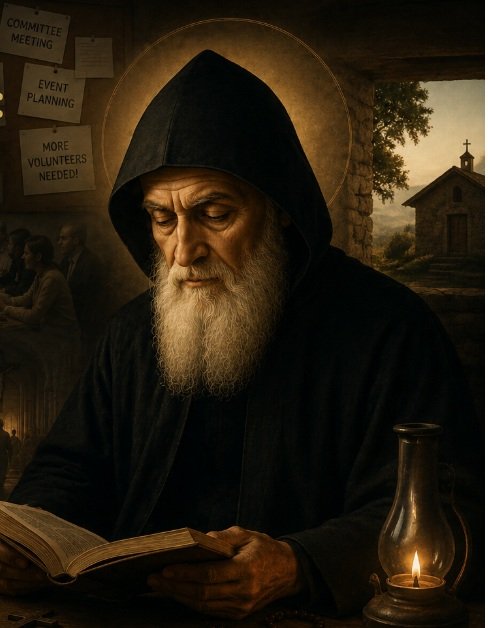
In our hyper-connected, hyper-busy world, spiritual exhaustion does not always stem from worldly temptations or secular pressure. Quite often, it creeps quietly into the lives of sincere, devout believers from within the very walls of the Church itself. Endless parish committees, organizational friction, volunteer overload, parish politics, and the noisy activism of modern ecclesiastical life can leave even the most dedicated Catholic feeling spiritually depleted, dry, and hollow.
When serving God begins to feel like running an exhausting corporate marathon, the human soul cries out for a return to what truly matters: an authentic, quiet, and unshakeable encounter with Jesus Christ.
Saint Charbel Makhlouf (1828–1898), the legendary Maronite hermit of the Monastery of Saint Maron in Annaya, Lebanon, offers the ultimate divine antidote to modern religious burnout. He did not run massive public ministries, hold high ecclesiastical offices, preach to packed stadiums, or publish theological bestsellers. Instead, he withdrew into absolute silence, hidden penance, and perpetual Eucharistic contemplation. Grounded in Sacred Scripture, ascetic theology, and dogmatic Catholic doctrine, this guide examines why church activity sometimes exhausts us and how Saint Charbel’s spirituality of hidden holiness can restore your interior peace and revive your soul.
Table of Contents
- The Hidden Reality of Spiritual Burnout in Church Life
- Theological Causes: Activism vs. Authentic Sanctity
- Biblical Foundations: Elijah, Martha, Mary, and the Desert Tradition
- Catholic Church Doctrine on Action, Contemplation, and Grace
- Saint Charbel’s Path: The Anatomy of Hidden Holiness
- The Temptation of Religious Vanity and Human Praise
- 5 Practical Ways to Reclaim Your Interior Life Today
- Prayer to Saint Charbel for Interior Peace and Quiet Holiness
- Frequently Asked Questions
- Final Reflection
The Hidden Reality of Spiritual Burnout in Church Life
It is one of the most heartbreaking paradoxes of the Christian journey: a believer sets out to serve God with a burning heart of charity, only to find themselves gradually drained by human conflict, ecclesiastical bureaucracy, and relentless parish activities.
Many faithful Catholics feel guilty for feeling tired of Church work. They worry that admitting burnout means they are losing their faith or abandoning their Christian duty. However, spiritual exhaustion is rarely a loss of faith; it is usually a sign that outward activity has detached itself from the interior source of life.
Spiritual exhaustion in parish life typically stems from four major traps:
- The Heresy of Action (Activism): Substituting outward Christian performance and event planning for an inward, silent, and transforming relationship with Jesus Christ.
- Human-Centered Expectations: Seeking approval, recognition, gratitude, or visible metrics of success from parish leadership or community members rather than looking to God alone.
- Spiritual Noise and Over-Stimulation: Bringing the chaotic, competitive, and noisy pace of modern secular culture into religious life, leaving zero room for silence, recollection, and interior prayer.
- Boundary-Less Service: Over-committing to voluntary roles while neglecting one’s primary state in life, such as marriage, family duties, or personal health.
![{"type":"elementor","siteurl":"https://osenhortedeapaz.com/wp-json/","elements":[{"id":"bd11c3e","elType":"widget","isInner":false,"isLocked":false,"settings":{},"defaultEditSettings":{"defaultEditRoute":"content"},"interactions":{},"elements":[],"widgetType":"e-image","editSettings":{"defaultEditRoute":"content"},"htmlCache":""}]}](https://osenhortedeapaz.com/wp-content/uploads/2026/08/SAINT-CHARBEL-MAKHLOUF-edited.jpg)
📚 This article is part of the Ultimate Guide to St. Charbel
If you want to discover the complete story of St. Charbel Makhlouf—from his childhood, religious vocation, and monastic life to the miracles recognized by the Church, the mystery of his incorrupt body, his prayers, the novena, his powerful intercession, and his extraordinary path to holiness—be sure to visit our Ultimate Guide to St. Charbel, the most comprehensive resource on our website about this beloved Maronite saint.
Theological Causes: Activism vs. Authentic Sanctity
The Catholic spiritual tradition has long cautioned against the subtle danger of “holy busyness.” Venerable Fulton Sheen and Pope Benedict XVI frequently warned that when Christians attempt to change the world without first allowing God to transform their interior souls, their work becomes sterile and prone to human bitterness.
When parish life becomes dominated by human effort rather than divine grace, ministry degenerates into mere event coordination. We begin to rely on our own talent, energy, and charisma rather than the supernatural power of the Holy Spirit. This shift from reliance on grace to reliance on human effort inevitably leads to spiritual collapse and emotional fatigue. Authentic sanctity, by contrast, is not measured by how much we do for God, but by how much space we allow God to occupy within us.
Biblical Foundations: Elijah, Martha, Mary, and the Desert Tradition
Sacred Scripture repeatedly warns believers against confusing spiritual noise with divine intimacy, reminding us that God reveals Himself not in the earthquake or the fire, but in the quiet sanctuary of a recollected heart.
- The Mystery of the Gentle Whisper: When the Prophet Elijah was physically, mentally, and spiritually exhausted from fighting religious battles against Jezebel’s prophets, God met him on Mount Horeb not in a rushing wind, an earthquake, or a fire, but in “a still small voice”—a gentle whisper of silence (1 Kings 19:11–12).
- Martha and Mary (Luke 10:38–42): When Martha became overwhelmed and frustrated by her extensive service (diakonia), Jesus gently corrected her priorities: “Martha, Martha, you are anxious and troubled about many things, but one thing is necessary. Mary has chosen the good portion, which will not be taken away from her” (Luke 10:41–42). Exterior service is commendable, but interior adoration must remain the foundation.
- Christ’s Secret Prayer Life: Despite massive crowds demanding miracles, teachings, and personal attention, Jesus consistently withdrew from public ministry to hidden places to pray in total silence: “And rising very early in the morning, while it was still dark, he departed and went out to a desolate place, and there he prayed” (Mark 1:35).
- The Hidden Life of Believers: Saint Paul reminds the Colossians where true spiritual authority and weight reside: “For you have died, and your life is hidden with Christ in God” (Colossians 3:3).
Catholic Church Doctrine on Action, Contemplation, and Grace
The Catholic Church has always maintained a sacred hierarchy between the active life and the contemplative life, dogmatically affirming that outward apostolic works are hollow unless sustained by interior contemplation.
Primacy of Contemplation
Action must always flow from an overflow of interior prayer and union with God (Catechism of the Catholic Church, 2709–2719). If the well of prayer runs dry, the water of action becomes polluted with self-seeking and pride.
The Grace of Sacred Silence
Silence is not empty air or an absence of sound; it is the language of God and the privileged medium through which sanctifying grace transforms the human soul (CCC 2717).
Fruitfulness of the Hidden Life
Hidden souls sustain the Mystical Body of Christ far more through silent prayer and hidden suffering than public figures do through visible activity (CCC 921).
- The Primacy of Contemplation (CCC 2711): The Catechism of the Catholic Church explains that contemplative prayer (oratio mentalis) is the heart of Christian life. Activity that does not spring from deep interior prayer degenerates into human ambition and spiritual exhaustion.
- The Role of Monasticism in the Mystical Body (CCC 921): The Church teaches that hermits and contemplatives are not escapees from reality. Rather, their hidden life of silence, penance, and unceasing prayer is “a silent preaching” of the Kingdom of God, providing invisible spiritual strength to those fighting in the world.
- Saint John of the Cross on Religious Busy-ness: The Great Doctor of the Church famously warned active ministers that those who are remarkably active and think they can embrace the world with their preaching and outward works would be much more useful to the Church if they spent half as much time in silent prayer.
Saint Charbel’s Path: The Anatomy of Hidden Holiness
Saint Charbel did not seek a public ministry, administrative power, preaching fame, or human recognition. After serving 16 years in a monastic community at St. Maron Monastary, he received permission from his superiors to retreat into the strict solitude of the Hermitage of Saints Peter and Paul in Annaya, where he remained for 23 years until his death in 1898.
1. Radical Sacred Silence
In a world addicted to noise, public commentary, and constant debates, Saint Charbel chose radical silence. He understood that the human tongue is easily entangled in gossip, judgment, complaint, and vanity. By guarding his tongue, he preserved his soul’s energy exclusively for divine contemplation. He spoke only when commanded by his monastic superiors and kept his eyes habitually lowered to guard his interior peace.
2. Eucharistic Centeredness
Saint Charbel’s entire day revolved around the Holy Sacrifice of the Mass. He spent three hours in intense mental preparation before steping to the altar to celebrate Holy Mass, and hours kneeling on the cold stone floor in silent thanksgiving before the Blessed Sacrament afterward. His spiritual vitality did not come from human encouragement or parish programs, but directly from the Real Presence of Jesus Christ in the Holy Eucharist.
3. Absolute Anonymity and Detachment
Saint Charbel refused to have his portrait taken during his lifetime, avoided worldly honors, and embraced total obscurity. He did not seek to be remembered by men. Yet, precisely because he hid himself completely in the heart of God, God exalted him after death, making his tomb a fountain of light and tens of thousands of miraculous physical and spiritual healings across the globe.
The Temptation of Religious Vanity and Human Praise
One of the subtlest dangers facing those involved in parish work is religious vanity—the desire to be seen, appreciated, and praised for one’s spiritual contributions. When we perform church duties to feel needed, respected, or prominent, we make ourselves vulnerable to extreme exhaustion when those around us fail to offer gratitude.
Saint Charbel’s life is a radical critique of religious vanity. He reminds us that God does not evaluate a soul based on public titles, parish leadership roles, or visible achievements. God looks at the hidden purity of intention. When we detach our hearts from the praise of men and seek only the silent approval of the Heavenly Father, the burden of parish burnout melts away, replaced by the holy freedom of divine sonship.
5 Practical Ways to Reclaim Your Interior Life Today
If parish work, religious activism, or church dynamics have left you feeling burned out, bitter, or spiritually dry, follow these five practical steps inspired by Saint Charbel to restore your interior peace:
1. Learn the Holy Art of Saying “No”
You are not the Savior of the world; Jesus Christ has already filled that role. You are not obligated to solve every problem or staff every committee in your parish. Step down gracefully from non-essential volunteer roles that drain your spiritual peace and undermine your interior life.
2. Guard Your Silence (Digital and Verbal Fasting)
Carve out 15 to 30 minutes of absolute, unbroken silence every single day. Turn off your phone, close your computer, step away from church news and social media debates, and sit quietly in the presence of God in your room or before the Tabernacle.
3. Shift from “Doing” to “Adoring”
Before you offer to organize another church event or lead another initiative, spend dedicated time kneeling before the Blessed Sacrament. Let Christ look at you, heal your interior wounds, and restore your spiritual strength in quiet Eucharistic Adoration.
4. Work in Secret Without Seeking Recognition
Purify your intentions by performing good works that no human being will ever see. Pray for your parish priest in secret, give alms anonymously, clean the chapel when no one is watching, and offer hidden sacrifices known only to God in Heaven (Matthew 6:3–4).
5. Prioritize Your Primary Vocation
God will judge you first on how you fulfilled your primary duty of state—your marriage, your parenthood, your daily work, and your personal prayer life—not how many parish committees you chaired. Realign your schedule so that your home life and personal sanctity take precedence over external church activities.
Prayer to Saint Charbel for Interior Peace and Quiet Holiness
In the Name of the Father, and of the Son, and of the Holy Spirit. Amen.
O Holy Hermit of Annaya, Saint Charbel, you who turned away from the noise, competition, and applause of the world to embrace the sweet solitude of God alone!
Look upon my soul today. You see how weary, noisy, and exhausted my spirit has become, even in the midst of religious duties and church life. I have allowed my activity to outpace my prayer, my service to outpace my love, and my tongue to outpace my heart.
Obtain for me, dear Saint Charbel, a spark of your deep love for sacred silence. Teach me to quiet my mind, to guard my speech against parish gossip and useless debates, and to find my true rest in Jesus in the Most Blessed Sacrament of the Altar.
Help me to remember that holiness is not measured by public success, parish titles, or human praise, but by a humble heart hidden with Christ in God. Grant me the grace of quiet endurance, interior peace, and a hidden, fervent love for God and my neighbor.
Saint Charbel, master of the interior life and silent intercessor for the suffering, pray for us! Amen.
(Recite 1 Our Father, 1 Hail Mary, and 1 Glory Be)
Frequently Asked Questions
Is it a sin to step back from parish activities when I am burned out?
No. Taking a temporary or permanent step back from voluntary parish ministries to restore your spiritual health, mental balance, and prayer life is an act of spiritual prudence. Your primary Christian duty is your personal relationship with God, your family obligations, and your state in life.
How do I handle parish gossip or church politics without getting bitter?
Follow Saint Charbel’s monastic example: do not participate in gossip, do not defend yourself endlessly, and do not spread complaints. Entrust human imperfections to divine mercy, pray secretly for those who cause friction, and redirect your attention away from human weakness and back to the Eucharistic Presence of Christ.
Can I practice “hidden holiness” if I am a lay person living in a busy family?
Yes, absolutely. Hidden holiness for a lay person means fulfilling your daily duties—cooking meals, working at your job, parenting children, cleaning the home, and enduring daily headaches—with patience, joy, and deep love for God, without seeking human applause or putting your religious devotion on public display.
What should I do if my priest or parish leader pressures me to keep volunteering?
Politely and firmly set boundaries. Explain that you need to focus on your family duties and personal spiritual life for a season. A wise pastor will understand and respect your need to care for your soul and family first.
Final Reflection
If church life or spiritual exhaustion has left your soul feeling parched, dry, and overburdened, remember this fundamental truth: God does not ask you for endless activity—He asks you for your heart.
Step back from the noise of public expectations, embrace the quiet mantle of Saint Charbel, sit in reverence before the Most Blessed Sacrament, and rediscover the profound joy of a life hidden with Christ. In the quiet sanctuary of your recollected soul, God is waiting right now to restore your strength, your peace, and your eternal joy.
About the Author
Wander Venerio Cardoso de Freitas is a theologian, educator, and author of books on Catholic spirituality, the lives of the saints, and Christian formation. He is the founder of the portal O Senhor Te Dê a Paz (Saints Library), dedicated to evangelization through articles, books, and digital content.
Continue Reading on Our Website
Deepen your devotion and explore more inspiring Catholic resources:
50 Inspiring Saint Charbel Quotes That Will Strengthen Your Faith and Bring You Closer to God
Why Pray the St. Charbel Novena? A Complete Guide to the Spiritual Power of Nine Days of Prayer
10 Timeless Lessons from Saint Charbel That Can Transform Your Relationship with God
Why Do Millions of People Pray to Saint Charbel? The Extraordinary Faith Behind the Miracles
Finding Quiet Strength in Suffering Through Saint Charbel
10 Saint Charbel Quotes on Suffering That Offer Comfort in Hard Times
Powerful Saint Charbel Quotes for Healing and Physical Illness
What Saint Charbel Teaches Us About Redemptive Suffering
Five Days With Saint Charbel: A Free Catholic Devotional for Faith, Hope, and Prayer
Inspiring Saint Charbel Words for Caregivers and Loved Ones
Saint Charbel Quotes to Pray During Times of Bodily Weakness
Saint Charbel Quotes for Chronic Pain Warriors Seeking Hope
Finding Meaning in Pain: Timeless Lessons from Saint Charbel
Saint Charbel on Divine Mercy During Physical Affliction
Saint Charbel Quotes on Bearing Your Daily Cross with Grace
Encouraging Saint Charbel Quotes for Hospital Patients
The Most Inspiring Quotes of Saint Charbel: Words of Faith, Prayer, and Silence
Saint Charbel Quotes When Healing Seems Impossible
Saint Charbel for Catholics Who Are Still Faithful but Secretly Losing Hope