
In today’s hyper-connected society, one of the greatest anxieties facing Christian mothers and fathers is the pervasive influence of technology on their children’s hearts and minds. From algorithm-driven social media addiction and online bullying to instant access to explicit material, gaming obsession, and digital isolation, the virtual world often feels like a minefield designed to strip young souls of their innocence, interior peace, and faith.
Many parents feel completely overwhelmed, wondering if it is even possible to raise a holy, happy child in an era dominated by smartphones, tablets, and constant digital stimulation.
Enter Saint Carlo Acutis (1991–2006), the first millennial saint of the Catholic Church. Carlo was not a monk living in a remote monastery, nor did he live in an era before the birth of the internet. He was a modern teenager who loved computer programming, video games, action movies, and building websites. Yet, instead of letting technology master him, Carlo mastered technology, transforming digital tools into instruments of evangelization, truth, and love.
Grounded in Sacred Scripture, the Magisterium of the Catholic Church, and the inspiring witness of Saint Carlo’s life, this comprehensive guide offers Catholic parents a theological vision and practical blueprint for guiding their children through the digital wilderness.
Table of Contents
- The Digital Crisis Facing the Catholic Family
- Who Was Carlo Acutis? The Cyber-Apostle of the Eucharist
- Biblical Principles for the Digital Age
- Catholic Church Teaching on Social Communications and Grace
- Saint Carlo’s 5 Golden Rules for Digital Sanctity
- Practical Steps for Parents: Transforming Screen Time into Holy Time
- Prayer to Saint Carlo Acutis for the Protection of Children’s Digital Souls
- Frequently Asked Questions
- Final Reflection
The Digital Crisis Facing the Catholic Family
The digital landscape has fundamentally reshaped the dynamics of childhood and family life. Where previous generations played outdoors and interacted face-to-face, modern children often spend hours staring into glowing screens that deliver endless streams of dopamine-inducing content.
Catholic parents rightly sense that this digital saturation carries grave spiritual, psychological, and relational risks:
- Loss of Interior Silence: Constant notifications and entertainment destroy a child’s capacity for stillness, quiet reflection, and mental prayer.
- Theft of Originality (“Copycat Culture”): Social media algorithms encourage children to conform to worldly trends, fashion, and secular ideologies rather than seeking their true identity in Christ.
- Exposure to Moral Corruption: Unfiltered internet access exposes young, impressionable minds to pornography, violence, occult practices, and distorted views of human sexuality.
- Family Isolation: Devices often erect invisible walls inside the home, replacing genuine family conversation and shared meals with isolated screen consumption.
Carlo Acutis recognized these exact dangers during the dawn of the internet age and consciously chose a radically different path.
Who Was Carlo Acutis? The Cyber-Apostle of the Eucharist
Born in London in 1991 to Italian parents and raised in Milan, Carlo Acutis was, in many ways, an ordinary modern child. He played soccer, learned to play the saxophone, loved dogs, and enjoyed video games such as PlayStation. He was fascinated by computer science, teaching himself coding, graphic design, and video editing at a very young age.
However, what made Carlo extraordinary was his supernatural center: Jesus Christ in the Most Holy Eucharist. Carlo called the Eucharist his “highway to Heaven.” From the day of his First Holy Communion at age seven, he never missed daily Mass, daily Rosary, or weekly Confession.
Rather than using his technological talents for personal fame or entertainment, Carlo spent years researching and building a global website documenting Eucharistic Miracles around the world. He understood that the internet was a neutral tool that could either be used to spread darkness or to illuminate minds with divine truth. When he died suddenly of fulminant leukemia at age 15 in 2006, his life left an indelible mark on the global Church, proving that teenagers can achieve heroic virtue amidst modern technology.
Biblical Principles for the Digital Age
Although the Bible was written thousands of years before the invention of the microchip, Sacred Scripture provides eternal moral principles that apply directly to how Christians use digital media:
- Guarding the Eyes and Mind: “I will not set before my eyes anything that is base” (Psalm 101:3). Jesus emphasized that the eye is the lamp of the body; what we choose to look at directly impacts the light or darkness within our souls (Matthew 6:22–23).
- Rejecting Conformity to the World: Saint Paul gives the ultimate antidote to social media peer pressure: “Do not be conformed to this world, but be transformed by the renewal of your mind, that by testing you may discern what is the will of God, what is good and acceptable and perfect” (Romans 12:2).
- Mastering All Things with Freedom: Saint Paul warns against digital addiction: “‘All things are lawful for me,’ but not all things are helpful. ‘All things are lawful for me,’ but I will not be dominated by anything” (1 Corinthians 6:12).
- Redeeming the Time: “Look carefully then how you walk, not as unwise but as wise, making the best use of the time, because the days are evil” (Ephesians 5:15–16). Screen time must never steal the precious time God gives us for prayer, family, and good works.
Catholic Church Doctrine on Social Communications and Grace
The Catholic Church does not view technology as inherently evil. In the Decree on the Media of Social Communications (Inter Mirifica), the Second Vatican Council affirmed that technological inventions are gifts of God’s providence meant to unite humanity and spread the Gospel.
1. Technology as an Instrument of Truth (Inter Mirifica, 2)
The Church teaches that digital media are tools that must be governed by a moral conscience. When used properly, media can promote truth, beauty, and authentic human communion.
2. The Danger of Digital Depersonalization (Fratelli Tutti, 42–50)
Pope Francis warned that digital connection is not equivalent to real human fraternity. Digital media can create a false sense of community while breeding loneliness, cyberbullying, and superficial relationships.
3. The Primacy of the Sacraments over Virtual Life
Catholic doctrine is fundamentally incarnational. No virtual experience, online Mass stream, or digital devotion can ever replace the physical reception of the Sacraments, the Real Presence of Christ in the Eucharist, and real-world works of mercy.
Saint Carlo’s 5 Golden Rules for Digital Sanctity
Carlo Acutis left parents and young people a clear, practical roadmap for maintaining spiritual purity and balance in a hyper-digital world:
1. “All Are Born as Originals, But Many Die as Photocopies”
Carlo constantly reminded his peers that God creates every human soul with unique gifts and a specific mission. He warned that mindless scrolling, chasing social media trends, and copying online influencers turn unique human beings into generic “photocopies.” Parents must help children root their identity in being sons and daughters of God, not in digital likes or follower counts.
2. Strict Self-Imposed Limits on Entertainment
Although Carlo loved playing video games, he recognized that gaming could easily become an idol that consumed his precious time. He voluntarily limited his gaming time to just one hour per week. This heroic act of temperance taught him digital self-control, freeing his mind for study, prayer, and helping the poor.
3. Using the Internet as an Instrument of Evangelization
For Carlo, the internet was not a digital playground for self-promotion; it was a digital pulpit. He utilized his computer skills to curate information on Eucharistic miracles and Marian apparitions, creating digital exhibitions that continue to convert souls today. He taught us that the best way to avoid digital filth is to fill our online presence with holy, noble, and truthful content.
4. Anchoring the Digital Soul in the Real Sacraments
Carlo knew that no one can withstand the temptations of the modern world on human willpower alone. He countered digital noise with daily Eucharistic Adoration and weekly Confession. He understood that receiving the Holy Eucharist frequently provides the spiritual immunity needed to stay pure in a hyper-sexualized online environment.
5. Active Charity over Virtual Passivity
Carlo did not spend his evenings isolated in his bedroom. After finishing his homework and prayer, he went out into the streets of Milan to give sleeping bags, food, and warm drinks to the homeless. He balanced his digital knowledge with real, hands-on Christian charity.
Practical Steps for Parents: Transforming Screen Time into Holy Time
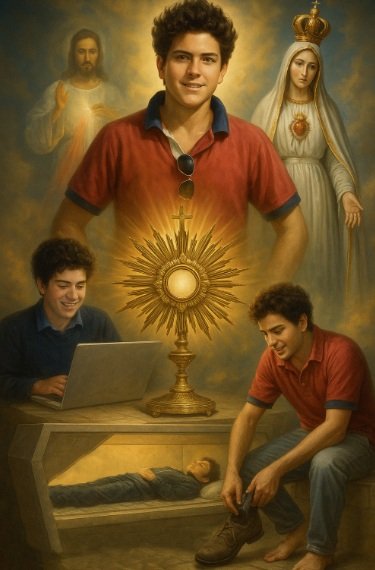
Parenting in the digital age requires a combination of clear boundaries, open communication, and personal example. Here are six practical strategies Catholic parents can implement immediately:
1. Establish “Device-Free Sacral Zones” in the Home
Designate specific areas and times in your home where screens are strictly forbidden. The kitchen dining table during family meals, family prayer time, and bedrooms at night should be entirely free of smartphones, tablets, and televisions.
2. Delay Smartphone Ownership and Social Media
Do not feel pressured by secular culture to give your child a smartphone at a young age. Consider basic phones without internet access for safety and communication, and delay social media access as long as possible. Educate them on the psychological and spiritual dangers of algorithms before granting access.
3. Practice Digital Transparency and Accountability
Implement parental control filters, block inappropriate websites, and maintain full access to your children’s passwords and devices. Remind them gently that privacy is different from secrecy: nothing done on a screen is hidden from the eyes of God (Hebrews 4:13).
4. Model Healthy Digital Habits Yourself
Children learn far more from what parents do than what they say. If parents are constantly glued to their smartphones, checking social media during family conversations, or watching television late into the night, children will imitate those exact habits. Show your children that you value their physical presence more than your phone screen.
5. Introduce Saint Carlo as a Real Friend and Role Model
Hang a picture of Saint Carlo Acutis near the family computer or study desk. Share his story with your children, watch documentaries about his life together, and teach them to ask for his intercession whenever they feel tempted by inappropriate online content or screen addiction.
6. Replace Screen Time with Real-World Family Fellowship
You cannot simply take away screen time without offering something far richer in return. Replace digital consumption with outdoor family outings, board games, reading good literature, practicing sports, and visiting the Blessed Sacrament together at your local parish.
Prayer to Saint Carlo Acutis for the Protection of Children’s Digital Souls
In the Name of the Father, and of the Son, and of the Holy Spirit. Amen.
O Glorious Saint Carlo Acutis, you who kept your heart pure, your mind clear, and your soul radiant in the middle of the modern digital age!
Look with compassion upon our children, who are growing up in a world filled with digital noise, moral confusion, and endless online distractions.
Intercede before the throne of Almighty God for our young people. Protect their eyes from impurity, guard their minds against addiction, and shield their hearts from the deceptive promises of secular culture. Teach them, as you lived, to recognize that they are created as unique originals in the image of God, and help them refuse to become photocopies of the world.
Give us, as parents, the wisdom, courage, and patience to guide our families with loving firmness. Grant us the grace to lead our children not toward screen addiction, but toward the true “highway to Heaven”—Jesus Christ present in the Most Holy Eucharist.
Saint Carlo Acutis, patron and protector of youth in the digital age, pray for our children and protect our families! Amen.
Recite 1 Our Father, 1 Hail Mary, and 1 Glory Be.
Frequently Asked Questions
At what age should I give my child a smartphone?
There is no single age fixed by Church law, but spiritual wisdom suggests delaying full smartphone access until a child demonstrates emotional maturity, strong prayer habits, and moral responsibility—often late high school. Prioritize basic communication devices without open internet access until then.
How do I handle a teenager who is already addicted to video games or social media?
Approach the situation with loving firmness rather than anger. Sit down with your teenager, share your genuine concern for their mental health and spiritual well-being, and work together to set clear, gradual time limits. Replace digital time with engaging real-world activities, family prayer, and sports.
Is it wrong for Catholic youth to enjoy video games or social media?
No. Media entertainment is morally neutral. Saint Carlo himself enjoyed playing video games and using computers. The key lies in virtue: moderation, self-control, avoiding sinful content, and ensuring that digital entertainment never displaces prayer, family duties, and the Sacraments.

Final Reflection
Raising holy children in a digital world is undoubtedly a formidable challenge, but it is not an impossible one. God did not place your family in this specific era by accident; He gave you your children precisely for this time in history, equipping you with the grace of the Sacrament of Matrimony to lead them to Heaven.
By leaning on the Sacraments, establishing wise digital boundaries, and following the luminous example of Saint Carlo Acutis, you can help your children navigate the digital wilderness safely, keeping their eyes fixed on the ultimate goal: eternal life with Jesus Christ.
About the Author
Wander Venerio Cardoso de Freitas is a theologian, educator, and author of books on Catholic spirituality, the lives of the saints, and Christian formation. He is the founder of the portal O Senhor Te Dê a Paz (Saints Library), dedicated to evangelization through articles, books, and digital content.
Continue Reading on Our Website
Deepen your devotion and explore more inspiring Catholic resources:
50 Inspiring Saint Charbel Quotes That Will Strengthen Your Faith and Bring You Closer to God
Why Pray the St. Charbel Novena? A Complete Guide to the Spiritual Power of Nine Days of Prayer
10 Timeless Lessons from Saint Charbel That Can Transform Your Relationship with God
Why Do Millions of People Pray to Saint Charbel? The Extraordinary Faith Behind the Miracles
Finding Quiet Strength in Suffering Through Saint Charbel
10 Saint Charbel Quotes on Suffering That Offer Comfort in Hard Times
Powerful Saint Charbel Quotes for Healing and Physical Illness
What Saint Charbel Teaches Us About Redemptive Suffering
Five Days With Saint Charbel: A Free Catholic Devotional for Faith, Hope, and Prayer
Inspiring Saint Charbel Words for Caregivers and Loved Ones
Saint Charbel Quotes to Pray During Times of Bodily Weakness
Saint Charbel Quotes for Chronic Pain Warriors Seeking Hope
Finding Meaning in Pain: Timeless Lessons from Saint Charbel
Saint Charbel on Divine Mercy During Physical Affliction
Saint Charbel Quotes on Bearing Your Daily Cross with Grace
Encouraging Saint Charbel Quotes for Hospital Patients
The Most Inspiring Quotes of Saint Charbel: Words of Faith, Prayer, and Silence
Saint Charbel Quotes When Healing Seems Impossible
Saint Charbel for Catholics Who Are Still Faithful but Secretly Losing Hope