How Saint Charbel Inspires Hope During Illness | Catholic Faith & Healing
Introduction
Few moments in life test our faith more deeply than illness.
Whether it is a sudden diagnosis, a chronic condition, the pain of watching a loved one suffer, or the uncertainty that comes with waiting for medical answers, sickness has a way of touching every part of our lives. It affects not only the body but also the mind, the emotions, and the spirit.
Questions naturally arise.
“Why is this happening?”
“Will things ever get better?”
“Where is God in all of this?”
These questions are not signs of weak faith.
They are deeply human.
Throughout history, countless believers have brought these same questions before God, trusting that even when they could not understand His plan, they could still rely on His love.
Among the saints who continue to inspire millions of people facing illness, Saint Charbel Makhlouf stands out as a remarkable witness of hope.
Although he lived a quiet life as a Maronite monk in the mountains of Lebanon during the nineteenth century, his example continues to comfort families around the world. Every year, people from many nations ask for his prayers, seeking strength, peace, healing, and the grace to trust God more deeply during times of suffering.
Yet the greatest gift Saint Charbel offers is not merely the hope of physical healing.
He teaches us something even more important:
True hope is found in Christ, whose love remains constant even in the darkest moments of life.
Whether healing comes quickly, slowly, or in ways we do not expect, God’s presence never abandons those who place their trust in Him.
This article explores how Saint Charbel’s life can encourage patients, caregivers, families, and anyone carrying the heavy burden of illness to discover a hope that reaches far beyond physical health.
When Illness Enters Our Lives
Illness often arrives without warning.
One medical appointment.
One phone call.
One unexpected diagnosis.
In a single moment, life can change completely.
For many people, the first response is fear.
Fear of pain.
Fear of uncertainty.
Fear of losing independence.
Fear for children, spouses, parents, or the future.
These emotions are completely understandable.
Even faithful Christians sometimes struggle to remain hopeful when confronted with suffering.
The Bible never tells us to pretend that pain does not exist.
Instead, Scripture repeatedly reminds us that God walks with His people through every trial.
King David wrote:
“Even though I walk through the valley of the shadow of death, I will fear no evil, for You are with me.” (Psalm 23:4)
Notice that God does not always remove the valley immediately.
He promises His presence within it.
That promise changes everything.
Hope Is More Than Optimism
Many people confuse hope with positive thinking.
Christian hope is something much deeper.
Optimism depends on favorable circumstances.
Hope depends on God.
Optimism says,
“Everything will probably work out.”
Christian hope says,
“No matter what happens, Christ will remain faithful.”
Saint Charbel lived this truth every day.
His confidence rested not in earthly security but in God’s infinite mercy.
That same hope is available to every believer today.
📚 This article is part of the Ultimate Guide to St. Charbel
If you want to discover the complete story of St. Charbel Makhlouf—from his childhood, religious vocation, and monastic life to the miracles recognized by the Church, the mystery of his incorrupt body, his prayers, the novena, his powerful intercession, and his extraordinary path to holiness—be sure to visit our Ultimate Guide to St. Charbel, the most comprehensive resource on our website about this beloved Maronite saint.
Who Was Saint Charbel?
Saint Charbel Makhlouf devoted his life entirely to prayer, silence, humility, and the Eucharist.
Born in 1828 in the mountains of Lebanon, he entered the Maronite monastery as a young man after discerning God’s call.
Rather than seeking recognition, he embraced a hidden life of simplicity.
He spent decades praying, working, fasting, serving his religious community, and growing ever closer to Christ.
Many people never heard his name while he was alive.
He did not preach to crowds.
He wrote no famous books.
He founded no large institutions.
Yet his quiet holiness became one of the greatest testimonies of God’s transforming grace.
After his death in 1898, devotion to Saint Charbel spread rapidly as countless people reported extraordinary favors received through his intercession.
Today he is recognized throughout the world as one of the Catholic Church’s most beloved saints associated with healing and hope.
Saint Charbel’s Deep Understanding of Human Suffering
One of the main reasons countless people turn to Saint Charbel during times of severe illness or emotional distress is that his spirituality was profoundly united with the suffering of Christ. His life was not a withdrawal from reality out of indifference, but rather an act of radical empathy. He willingly embraced a life of quiet sacrifice, strict fasting, solitude, and exhaustive hours of prayer, offering every moment of discomfort for the redemption and healing of others.
This severe discipline did not mean Saint Charbel viewed human pain as inherently good or desirable in itself. Rather, he understood that when suffering is consciously offered to God, it loses its power to corrupt the spirit and instead becomes a sacred vessel for deeper love, spiritual maturity, and unshakeable trust. In a world that often flees from discomfort, his life remains a striking testament to finding purpose within hardship.
This perspective directly reflects the profound teaching of Saint Paul:
“I rejoice in my sufferings for your sake, and in my flesh I am filling up what is lacking in Christ’s afflictions for the sake of his body, that is, the church.” (Colossians 1:24)
Saint Paul was not celebrating raw pain, nor was he suggesting that Christ’s redemption was incomplete. Instead, he was pointing to the transformative mystery of grace, showing how Christ invites believers to participate actively in His redeeming work. Through this lens, personal trials are stripped of their isolation and integrated into a higher, eternal purpose.
Saint Charbel lived this profound mystery with remarkable humility and quiet dignity. He never sought attention for his mortifications, nor did he lecture others on endurance. Instead, he absorbed the sorrows, sicknesses, and intentions of those who sought his aid, carrying their heavy burdens to God in silent adoration.
Even long after his death, his legacy as a miraculous healer continues to draw millions of pilgrims to Annaya, Lebanon, seeking both physical relief and spiritual consolation. He serves as a timeless reminder that even in our darkest moments of illness or despair, human suffering is never wasted when entrusted to the hands of God. Through his example, believers find the courage to transform their own crosses into bridges of faith, hope, and ultimate restoration.
Jesus Never Abandons the Sick
Throughout the Gospels, Jesus repeatedly shows extraordinary compassion toward those who suffer.
He touches lepers.
He heals the blind.
He comforts grieving parents.
He raises the dead.
He forgives sinners.
Again and again, Christ reveals that no suffering person is forgotten.
Sometimes He heals immediately.
Sometimes He heals gradually.
Sometimes He strengthens people to carry their crosses with extraordinary courage.
In every case, His love remains the same.
Saint Charbel continually points people toward this compassionate Savior.
His life reminds us that every prayer ultimately leads us to Jesus.
Hope for Families and Caregivers
Illness rarely affects only one person.
Behind every patient stands a family carrying its own burdens.
Parents watching children suffer.
Children caring for aging parents.
Spouses supporting one another through long treatments.
Friends offering encouragement during difficult days.
Caregivers often experience emotional exhaustion while trying to remain strong for others.
Saint Charbel’s example reminds families that they do not carry these burdens alone.
Prayer becomes a source of strength when human energy feels exhausted.
Faith becomes an anchor when emotions are overwhelmed.
God often works quietly through doctors, nurses, caregivers, family members, parish communities, and compassionate friends.
His grace frequently arrives through the loving hands of those who care for the sick.
Five Lessons Saint Charbel Teaches During Illness
1. Never Lose Hope
Even when circumstances appear impossible, God continues working in ways we cannot always see.
2. Pray with Confidence
Prayer does not force God to act according to our plans.
Prayer opens our hearts to His loving will.
3. Unite Your Suffering with Christ
Jesus understands pain because He embraced the Cross.
No suffering offered to Him is ever meaningless.
4. Accept Help from Others
God often answers prayers through family members, healthcare professionals, friends, and the Christian community.
Receiving help is not weakness.
It is an act of humility.
5. Remember That Healing Takes Many Forms
Physical healing is a beautiful gift.
But God also heals wounded hearts.
Broken relationships.
Fear.
Loneliness.
Hopelessness.
Sometimes the greatest miracle is discovering peace in the middle of life’s greatest storm.
Reflection
If you or someone you love is facing illness today, remember this:
God has not forgotten you.
Your prayers matter.
Your tears matter.
Your suffering is seen by Christ.
Saint Charbel’s life reminds us that hope does not depend on changing circumstances.
Hope is rooted in the unchanging love of God.
Even when answers seem delayed, God continues to walk beside His children with infinite compassion, mercy, and faithfulness.
Miracles and the Catholic Understanding of Healing
For more than a century, millions of people have turned to Saint Charbel during times of illness, asking for his prayers with confidence and hope. His shrine in Annaya, Lebanon, has become one of the world’s most visited Catholic pilgrimage sites, where countless pilgrims seek spiritual renewal and pray for healing.
Many people have shared testimonies of receiving remarkable graces after asking for Saint Charbel’s intercession. Some speak of physical recoveries, while others describe emotional healing, restored relationships, renewed faith, or the strength to endure difficult medical treatments with peace.
The Catholic Church approaches these accounts with great care.
Before recognizing a miracle, the Church conducts thorough investigations involving medical experts, theologians, and Church authorities. Only after careful examination does the Church officially acknowledge a miracle connected with a saint’s intercession.
This careful process reminds us of an important truth:
Catholics do not place their faith in miracles—they place their faith in Jesus Christ.
Miracles are signs that point toward God’s love and power. They strengthen faith, encourage trust, and remind us that God is still active in the lives of His people today.
Saint Charbel never draws attention to himself.
His entire life directs our hearts toward Christ.
Healing Is More Than Physical Recovery
When we hear the word healing, we often think only about the body.
The Gospel presents a much richer picture.
Jesus certainly healed physical illnesses, but He also healed hearts wounded by fear, loneliness, guilt, grief, and despair.
Sometimes the greatest miracle is not the removal of suffering.
Sometimes it is discovering God’s peace in the middle of suffering.
A patient may continue chemotherapy while experiencing an unexpected inner peace.
A family may still face uncertainty while finding the strength to remain united.
Someone carrying chronic pain may discover a renewed purpose and deeper relationship with Christ.
These are also beautiful expressions of God’s healing grace.
Saint Charbel reminds us that God’s work is never limited to what we can immediately see.
Keeping Hope Alive During Illness
Hope requires daily attention.
Like a small flame, it must be protected and nourished.
When illness becomes overwhelming, these simple spiritual practices can help strengthen faith.
Spend Time in Prayer
Prayer does not need to be complicated.
Sometimes the most powerful prayer is simply saying:
“Jesus, I trust in You.”
Speak honestly to God.
Tell Him about your fears.
Your questions.
Your pain.
Your hopes.
He already knows your heart.
Stay Close to the Sacraments
Whenever possible, receive the Eucharist and the Sacrament of the Anointing of the Sick according to the teaching and practice of the Catholic Church.
These sacraments bring spiritual strength, comfort, forgiveness, and grace during times of illness.
Many Catholics who have experienced serious sickness describe the sacraments as a profound source of peace.
Anchor Your Heart in God’s Word
Scripture reassures us that God’s promises stand firm, even in the hardest seasons. Here are a few comforting passages to reflect on:
- Psalm 23 – Finding rest in the Shepherd
- Isaiah 41:10 – Strength when you feel weak
- Matthew 11:28–30 – Rest for the weary
- Romans 8:28 – Hope in all circumstances
- John 14:27 – A peace the world cannot give
Spending just a few moments in His Word each day can deeply renew your hope.
Accept the Support of Others
Illness is not meant to be faced alone.
Allow family members, friends, parish communities, and healthcare professionals to help.
Sometimes God’s answer to our prayers comes through the kindness of others.
Receiving help is not a sign of weakness.
It is often an invitation to experience God’s love through His people.
Practice Gratitude
Gratitude does not ignore suffering.
It helps us recognize that God continues to give good gifts even in difficult seasons.
A kind nurse.
A supportive spouse.
A child’s smile.
A peaceful afternoon.
A successful treatment.
Every blessing becomes a reminder that God is still present.
A Reflection for Caregivers
Caregivers often carry invisible burdens.
They manage medications.
Attend appointments.
Offer encouragement.
Lose sleep.
Hide their own fears while comforting someone they love.
If you are caring for a family member or friend, remember this:
God sees your sacrifices.
Every act of compassion reflects Christ’s own love.
Even when no one else notices your quiet service, God does.
Saint Charbel spent much of his life serving quietly without seeking recognition.
His example encourages caregivers to remember that every hidden act of love has eternal value.
A Prayer to Saint Charbel During Illness
Heavenly Father,
You are the source of all life, healing, and hope.
In every season of suffering, You remain faithful and full of mercy.
Through the loving intercession of Saint Charbel, we place before You all who are sick, discouraged, or burdened by illness.
Lord Jesus, touch those who are suffering in body, mind, or spirit.
Grant wisdom to doctors, nurses, therapists, and all healthcare professionals who care for the sick.
Strengthen families who walk beside their loved ones through difficult treatments and uncertain days.
Saint Charbel, faithful servant of Christ, pray for us.
Help us trust God’s plan even when we do not understand it.
Teach us to remain faithful in prayer.
Give us courage when we feel afraid.
Fill our hearts with peace that the world cannot give.
If it is God’s holy will, ask Him to grant healing.
If healing comes in another way, help us accept His grace with confidence and hope.
Above all, lead us closer to Jesus, who is our true physician, our comfort, and our eternal hope.
We ask this through Christ our Lord.
Amen.
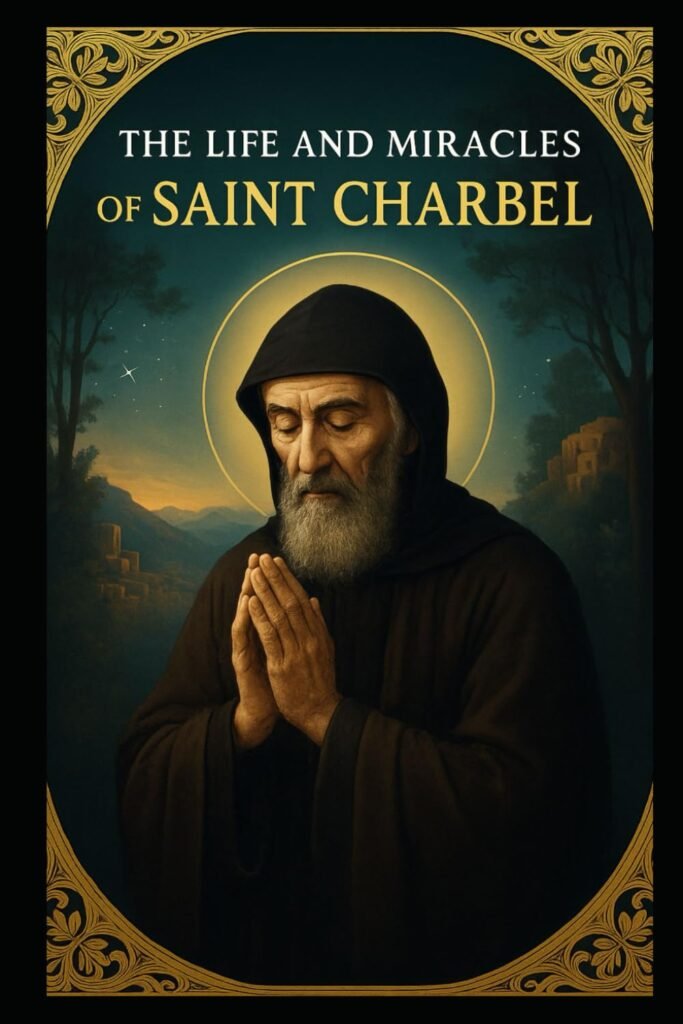
Book Recommendation: Discover the Power and Faith of St. Charbel
Title: The Life and Miracles of Saint Charbel
- Format: Paperback/Kindle
- Rating: ⭐⭐⭐⭐⭐ 5.0 out of 5 stars
Why You Should Read The Life and Miracles of Saint Charbel
If you are looking for a deeply inspiring spiritual journey, “The Life and Miracles of Saint Charbel” by Wander Venerio is a must-read for Catholics and spiritual seekers alike.
Frequently Asked Questions
Why do Catholics pray to Saint Charbel?
Catholics ask Saint Charbel to pray for them because they believe the saints are alive with Christ in Heaven and continue to intercede for the Church. All grace and healing come from God alone.
Is Saint Charbel the patron saint of healing?
While he is especially known around the world for his association with healing and miracles, Catholics ultimately place their trust in Jesus Christ, the Divine Physician.
Does praying to Saint Charbel guarantee a miracle?
No.
Prayer is an act of trust, not a guarantee of a particular outcome.
God always answers prayer according to His wisdom, love, and perfect will.
What if healing does not happen?
The Catholic faith teaches that God never abandons His children.
Sometimes His greatest gift is not immediate physical healing but the grace, peace, courage, and spiritual strength needed to endure suffering with hope.
Can non-Catholics ask Saint Charbel to pray for them?
Anyone may ask for Saint Charbel’s intercession.
His life continues to inspire Christians and many people around the world to place greater trust in God’s mercy.
Final Reflection
Illness has the power to change every aspect of life.
It can challenge our plans, test our patience, and leave us searching for answers we cannot immediately find.
Yet the story of Saint Charbel reminds us that suffering never has the final word.
Christ does.
Hope is not built upon medical reports, changing circumstances, or human strength alone.
It is built upon the unchanging love of God.
Saint Charbel’s quiet life teaches us that even in weakness, God’s grace is powerful.
Even in uncertainty, His promises remain true.
Even in tears, hope can flourish.
If you or someone you love is facing illness today, remember that you are not walking this road alone.
God walks beside you.
The Church prays with you.
And through the communion of saints, Saint Charbel continues to inspire countless people to trust in Christ with renewed faith and unwavering hope.
May his example encourage you to place every fear, every prayer, and every burden into the loving hands of Jesus.
About the Author
Wander Venerio Cardoso de Freitas is a theologian, educator, and author of books on Catholic spirituality, the lives of the saints, and Christian formation. He is the founder of the portal O Senhor Te Dê a Paz (Saints Library), dedicated to evangelization through articles, books, and digital content.
Continue Reading on Our Website
Deepen your devotion and explore more inspiring Catholic resources:
50 Inspiring Saint Charbel Quotes That Will Strengthen Your Faith and Bring You Closer to God
Why Pray the St. Charbel Novena? A Complete Guide to the Spiritual Power of Nine Days of Prayer
10 Timeless Lessons from Saint Charbel That Can Transform Your Relationship with God
Why Do Millions of People Pray to Saint Charbel? The Extraordinary Faith Behind the Miracles
Finding Quiet Strength in Suffering Through Saint Charbel
10 Saint Charbel Quotes on Suffering That Offer Comfort in Hard Times
Powerful Saint Charbel Quotes for Healing and Physical Illness
What Saint Charbel Teaches Us About Redemptive Suffering
Five Days With Saint Charbel: A Free Catholic Devotional for Faith, Hope, and Prayer
Inspiring Saint Charbel Words for Caregivers and Loved Ones
Saint Charbel Quotes to Pray During Times of Bodily Weakness
Saint Charbel Quotes for Chronic Pain Warriors Seeking Hope
Finding Meaning in Pain: Timeless Lessons from Saint Charbel
Saint Charbel on Divine Mercy During Physical Affliction
Saint Charbel Quotes on Bearing Your Daily Cross with Grace
Encouraging Saint Charbel Quotes for Hospital Patients
The Most Inspiring Quotes of Saint Charbel: Words of Faith, Prayer, and Silence
Saint Charbel Quotes When Healing Seems Impossible
Saint Charbel for Catholics Who Are Still Faithful but Secretly Losing Hope