
It is one of the most painful, hidden ironies of Christian parish life.
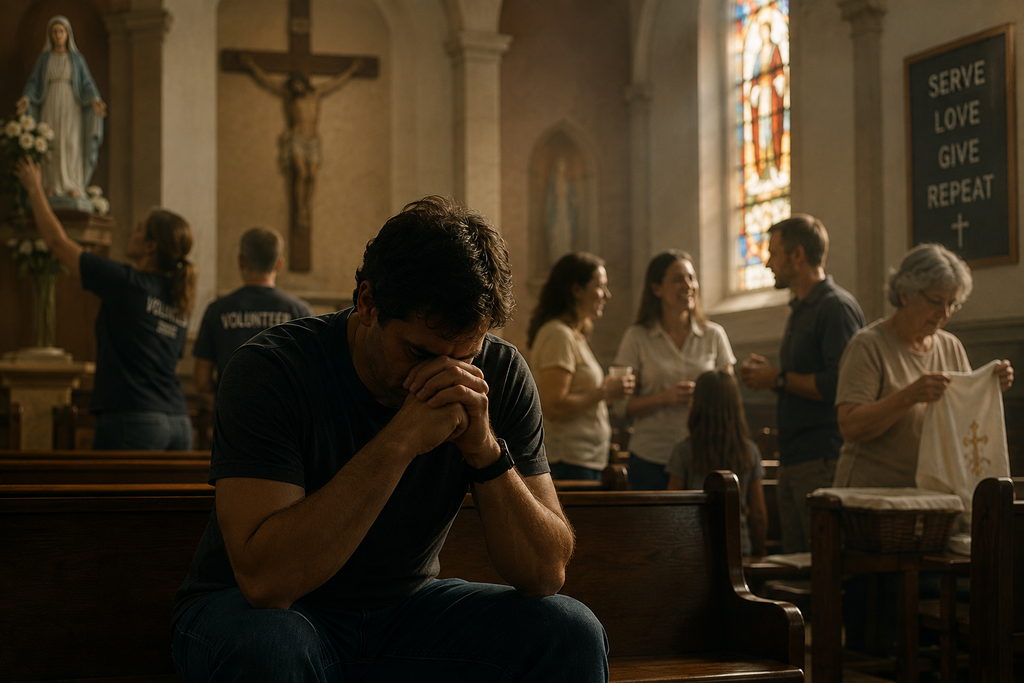
You are the person everyone calls when a volunteer is needed. You organize the events, set up the chairs, teach the catechism classes, lead the choir, clean the altar linens, or spend long hours listening to the heartbreak, heavy burdens, and constant complaints of others. To the outside world, you are the indisputable pillar of your parish community—always active, always giving, always dependable, and seemingly spiritually invincible.
Yet, when the lights in the parish hall finally turn off, the crowd disperses, and everyone goes home to their families, a cold, heavy reality settles over your heart: you serve everyone, but you have no one to talk to.
No one asks how your soul is doing. No one checks in on your personal pain, your family trials, or your interior weariness. When you attempt to share your own struggles, people often brush them aside, assuming that because you are so spiritually active and capable, you do not need human support or spiritual comfort. You find yourself surrounded by crowds of parish acquaintances, yet you feel profoundly, heartbreakingly alone.
When the heavy burden of silent, unappreciated service threatens to crush your spirit, Saint Charbel Makhlouf (1828–1898), the Maronite hermit of Lebanon, steps forward as your heavenly brother and friend. Grounded in Sacred Scripture, the Catechism of the Catholic Church, and the witness of a saint who lived in total solitude, this guide explores why active servants suffer from hidden isolation and how Saint Charbel can accompany your lonely heart.
Table of Contents
- The Hidden Isolation of the Active Catholic Servant
- The Difference Between Function and Fraternity in Parish Life
- Theological Causes: Activism, Expectations, and Spiritual Exhaustion
- Biblical Foundations: The Solitude of Moses, Elijah, Paul, and Christ
- Catholic Church Doctrine on Sacred Solitude, Grace, and Friendship
- Saint Charbel: The Hermit Who Becomes the Friend of the Lonely
- The Temptation of Bitterness and How to Guard the Heart
- 5 Practical Steps for the Isolated Catholic Servant
- Prayer to Saint Charbel for the Lonely Servant
- Frequently Asked Questions
- Final Reflection
The Hidden Isolation of the Active Catholic Servant
Spiritual loneliness in the middle of active church service is not a sign of personal failure, weak faith, or ingratitude. It is a specific, heavy spiritual cross borne by those who give themselves generously to others without reserving time for their own spiritual replenishment.
When a Catholic enters public or parish ministry, an invisible barrier often forms between them and the rest of the community:
- The Expectation of Perpetual Strength: People begin to view you exclusively as a provider of spiritual help rather than a human being who needs grace, comfort, and human warmth. They come to you to unload their emotional burdens, assuming you have no burdens of your own.
- Superficial Community Connections: Parish life is often filled with purely functional relationships—discussing event logistics, meeting schedules, and committee tasks—while true, soul-deep spiritual friendships remain remarkably rare.
- The “Servant’s Mask”: Out of a desire to be a good witness, servants often feel forced to put on a smiling, capable exterior, hiding their interior exhaustion, doubts, and personal pain from those around them.
- Forgotten Personal Need: Because you are always giving, others assume your well is naturally full, failing to realize that without deep interior prayer and mutual support, even the most dedicated servant will run completely dry.
The Difference Between Function and Fraternity in Parish Life
In many modern parishes, the busyness of organization can easily replace authentic Christian fraternity. We become experts at running events, coordinating liturgical schedules, and managing ministries, yet we remain strangers to the interior lives of those sitting next to us in the pews.
Function is about what you do for the Church; fraternity is about who you are in Christ. When function eclipses fraternity, the church becomes a workplace rather than a spiritual family. Servants begin to feel valued only for their utility—what they can produce or organize—rather than loved simply as children of God. This tragic shift turns holy service into a lonely, exhausting job.
Theological Causes: Activism, Expectations, and Spiritual Exhaustion
The Catholic spiritual tradition has long warned against the subtle danger of “spiritual activism”—the error of prioritizing the work of the Lord over the Lord of the work. When our active service outpaces our interior life of prayer, we begin to operate on mere human energy.
When we rely on human strength, we inevitably seek human gratitude, understanding, and emotional validation. But when parish leaders or community members fail to notice our sacrifices, the human heart quickly experiences deep disappointment, isolation, and burnout. Authentic Catholic service must be rooted in divine grace, where God alone is our ultimate reward and source of life.
Deepen Your Faith with the Story of Saint Charbel
If you were moved by this article, discover the complete journey of faith, silence, and supernatural healings in The Life and Miracles of Saint Charbel by Wander Venerio Cardoso de Freitas.
Discover how a humble Lebanese hermit became one of the Catholic Church’s greatest miracle workers.
Explore the documented miracles and official healings recognized by the Church.
Renew your daily prayer life with timeless spiritual lessons.
🛒 [Get Your Paperback / Kindle Copy on Amazon]
Biblical Foundations: The Solitude of Moses, Elijah, Paul, and Christ
If you feel completely isolated while serving God’s people, you are in holy biblical company. The greatest servants in salvation history experienced this exact same heavy trial:
- Moses Carrying the People Alone: Overwhelmed by the constant complaints and emotional demands of the Israelites in the wilderness, Moses cried out to God in total exhaustion: “I am not able to carry all this people alone, the burden is too heavy for me” (Numbers 11:14).
- Elijah’s Sense of Total Isolation: After fighting false prophets and serving God tirelessly, the Prophet Elijah fled into the wilderness, sat under a broom tree, and prayed for death: “It is enough; now, O Lord, take away my life… I, even I only, am left” (1 Kings 19:4, 10).
- Saint Paul’s Abandonment: Writing from a cold Roman prison cell after spending his entire life founding churches and serving thousands, Saint Paul wrote poignantly: “At my first defense no one came to stand by me, but all deserted me” (2 Timothy 4:16).
- Christ in Gethsemane: The ultimate Servant, Jesus Christ, gave Himself completely to the crowds, healing and teaching them daily. Yet, in His hour of deepest agony in the Garden of Gethsemane, His closest friends fell asleep, leaving Him to suffer and pray in total solitude (Matthew 26:40).
Catholic Church Doctrine on Sacred Solitude, Grace, and Friendship
The Catholic spiritual tradition, codified in the Catechism of the Catholic Church, recognizes that human loneliness, when united to the Passion of Christ, can be transformed into a vessel of extraordinary supernatural grace.
1. The Primacy of the Interior Life (CCC 2014)
The Catechism teaches that spiritual progress tends toward an ever more intimate union with Christ. This union is called “mystical” because it participates in the mystery of Christ through the sacraments. External service is only fruitful when it flows directly from this interior union.
2. The Grace of Sacred Silence (CCC 2717)
Contemplative prayer is silence, the “symbol of the world to come” or “silent love.” Words in this kind of prayer are not speeches, but kindling that feeds the fire of love. In silence, God speaks to the heart that feels abandoned by human friends.
3. The Communion of Saints (CCC 946–953)
Catholic doctrine teaches that no believer is ever truly alone. When you sit in an empty church or a quiet room after an exhausting day of service, you are surrounded by the invisible cloud of witnesses—the angels and saints who see your hidden sacrifices and hold your weary spirit before God.
4. Holy Friendship (Amicitia Sacra)
Saint Thomas Aquinas taught that genuine spiritual friendship is a precious gift from God. However, the Church acknowledges that in certain seasons of life, God permits a lack of human friendship so the soul learns to lean entirely upon Him as its primary confidant.
Saint Charbel: The Hermit Who Becomes the Friend of the Lonely
Why should a Catholic who feels lonely turn specifically to Saint Charbel Makhlouf?
Saint Charbel spent 23 years in the extreme solitude of the Hermitage of Saints Peter and Paul in Annaya, Lebanon. He lived in a tiny, unheated cell, spoke to almost no one except his superior under obedience, ate frugal meals, and spent hours kneeling in absolute silence before the Tabernacle.
Humanly speaking, Saint Charbel was completely cut off from the world. He had no social circle, no human confidants, no public praise, and no earthly comforts. Yet, he was not lonely—because his heart was entirely filled by the presence of God in the Holy Eucharist.
Because Saint Charbel mastered the art of holy silence and interior solitude, he understands your hidden isolation better than anyone else.
- He Sees What Others Miss: Saint Charbel loved the hidden life. When parish leaders, friends, or family fail to notice your fatigue and sacrifices, Saint Charbel looks upon your quiet work with deep heavenly affection.
- He Teaches You to Rest in the Eucharist: When you have no human person to pour your heart out to, Saint Charbel points you directly to the Tabernacle. He shows you how to sit before Jesus in the Blessed Sacrament and tell Him everything you cannot say to others.
- He Turns Isolation into Intercession: Saint Charbel proved that a soul hidden from the world can touch millions of lives. He teaches you that your quiet, unacknowledged service is carrying invisible spiritual weight for the salvation of souls.
The Temptation of Bitterness and How to Guard the Heart
When you serve continuously without receiving appreciation or emotional support, a subtle and dangerous temptation creeps into the soul: bitterness. Bitterness manifests as silent resentment toward parish priests, anger at fellow parishioners who “do less,” and a cold cynicism toward ministry itself.
Saint Charbel offers us the antidote to bitterness through radical humility. When we realize that we serve for Christ alone—and not for human applause, gratitude, or recognition—our heart is protected from offense. When no one thanks you, remind your soul that your reward is stored in Heaven (Matthew 6:4), where no hidden act of love is ever lost or forgotten.
5 Practical Steps for the Isolated Catholic Servant
If you feel completely spent, serving everyone around you while having no one to talk to, implement these five practical steps to protect your soul:
1. Pour Your Heart Out in Unfiltered Eucharistic Prayer
Stop pretending to be strong when you sit before the Blessed Sacrament. Tell Jesus exactly how tired, lonely, and overlooked you feel. Use the raw honesty of the Psalms. Christ already knows your heart; dropping your “servant’s mask” in His presence brings immediate supernatural relief.
2. Seek an Exterior Spiritual Director or Confessor
If you cannot open up to people within your immediate parish circle because of your public role, seek a wise spiritual director, priest, or counselor from outside your local community. Having a safe, confidential space to speak openly about your soul is essential for long-term spiritual health.
3. Establish Healthy Boundaries on Your Giving
You cannot be everyone’s savior; that role belongs exclusively to Jesus Christ. Practice saying a gentle, firm “no” to non-essential requests that drain your spiritual peace and destroy your interior life. Remember that taking time to rest, pray, and care for your soul is an act of stewardship, not selfishness.
4. Adopt Saint Charbel as Your Daily Confidential Friend
Make a habit of speaking to Saint Charbel throughout your day. When you finish a long church event and feel nobody noticed your effort, say quietly in your heart: “Saint Charbel, you see my work. Offer this hidden sacrifice to Jesus for me.”
5. Prioritize Family and the Primary Duty of State
God will evaluate your life based on how you fulfilled your primary vocation—your marriage, your parenthood, your daily work, and your personal prayer—not how many parish committees you led. Reclaim time for your family and personal rest before committing to extra church activities.
Prayer to Saint Charbel for the Lonely Servant
In the Name of the Father, and of the Son, and of the Holy Spirit. Amen.
O Holy Hermit of Annaya, Saint Charbel, you who spent your life in hidden solitude, wrapped in the silent love of God and the perpetual adoration of the Holy Eucharist!
Look with tenderness upon my weary soul today. You see how much I give to others, how many burdens I carry for my parish, my family, and my community. You see how surrounded I am by people, yet how deeply isolated and alone my heart feels.
I come to you, dear Saint Charbel, because you understand the silence. When I have no human friend to talk to, no one to share my tears with, and no one to notice my exhaustion, be my heavenly companion and friend.
Obtain for me from Jesus the grace to find my rest in His Tabernacle. Help me to drop my mask of strength before Him and to realize that my value comes not from human praise or parish success, but from being a beloved child of God.
Teach me to transform my loneliness into a holy sanctuary where I meet Christ alone. Grant me the grace to keep serving with love, the wisdom to set holy boundaries, and the peace of knowing that my hidden sacrifices are precious in Heaven.
Saint Charbel, silent friend of the overburdened and lonely servant, pray for me! Amen.
(Recite 1 Our Father, 1 Hail Mary, and 1 Glory Be)
Frequently Asked Questions
Is it wrong or sinful to feel resentful when no one checks on me?
Feeling a natural rise of sadness or frustration when you are ignored is a human emotion, not a sin. However, letting that resentment fester into anger, gossip, or coldness is spiritually dangerous. Bring those raw feelings directly to Christ in prayer and ask Him to heal your wounded heart.
Should I step down from my parish ministries if I feel this isolated?
If your isolation and burnout are severely harming your mental health, your prayer life, or your family duties, taking a temporary sabbatical from parish ministries is wise and prudent. Step back, allow your soul to be nourished by the Sacraments, and return to service only when your interior well is replenished.
How can I find authentic Catholic friends who actually care about my soul?
Pray specifically for the gift of holy friendship (Amicitia Sacra). Look for small prayer groups, Eucharistic Adoration chapels, or spiritual retreats outside your daily ministry work where you can meet other believers as a fellow disciple rather than a leader or organizer.
How do I handle parish leaders who expect me to do everything?
Communicate your limits clearly, humbly, and early. Explain that to maintain your primary state in life and spiritual health, you must step back from certain responsibilities. A healthy pastor will respect your boundaries and encourage your personal well-being.
Final Reflection
If you are the Catholic who serves everyone but has no one to talk to, take heart today.
Your hidden tears are not wasted. Your unspoken fatigue is not forgotten. Your quiet, unthanked service is seen in its full, radiant beauty by the Heavenly Father who sees in secret (Matthew 6:4).
When the silence of your house or church feels overwhelming, reach out to Saint Charbel. Let the silent hermit of Lebanon teach you that in the quiet sanctuary of your soul, Jesus is waiting to be the friend who never leaves, never forgets, and never stops loving you.
About the Author
Wander Venerio C. de Freitas is a Brazilian Catholic theologian, educator, and author dedicated to promoting authentic Catholic spirituality through Sacred Scripture, Sacred Tradition, the Catechism of the Catholic Church, and the witness of the saints. Through The Lord of Peace, he publishes in-depth articles designed to help readers deepen their relationship with Jesus Christ, grow in faith, and discover the timeless wisdom of the Catholic Church.
Continue Reading on Our Website
Deepen your devotion and explore more inspiring Catholic resources:
50 Inspiring Saint Charbel Quotes That Will Strengthen Your Faith and Bring You Closer to God
Why Pray the St. Charbel Novena? A Complete Guide to the Spiritual Power of Nine Days of Prayer
10 Timeless Lessons from Saint Charbel That Can Transform Your Relationship with God
Why Do Millions of People Pray to Saint Charbel? The Extraordinary Faith Behind the Miracles
Finding Quiet Strength in Suffering Through Saint Charbel
10 Saint Charbel Quotes on Suffering That Offer Comfort in Hard Times
Powerful Saint Charbel Quotes for Healing and Physical Illness
What Saint Charbel Teaches Us About Redemptive Suffering
Five Days With Saint Charbel: A Free Catholic Devotional for Faith, Hope, and Prayer
Inspiring Saint Charbel Words for Caregivers and Loved Ones
Saint Charbel Quotes to Pray During Times of Bodily Weakness
Saint Charbel Quotes for Chronic Pain Warriors Seeking Hope
Finding Meaning in Pain: Timeless Lessons from Saint Charbel
Saint Charbel on Divine Mercy During Physical Affliction
Saint Charbel Quotes on Bearing Your Daily Cross with Grace
Encouraging Saint Charbel Quotes for Hospital Patients
The Most Inspiring Quotes of Saint Charbel: Words of Faith, Prayer, and Silence
Saint Charbel Quotes When Healing Seems Impossible
Saint Charbel for Catholics Who Are Still Faithful but Secretly Losing Hope