
It is the defining paradox of Generation Z and Generation Alpha.
You have hundreds of friends on Snapchat, thousands of followers on Instagram, endless streams on TikTok, and constant group chats pinging on your phone. To an older generation, you look like the most connected young person in human history.
Yet, when you put your phone down on your nightstand and the screen goes dark, a heavy, quiet ache fills the room: you are surrounded by digital noise, but you feel completely, utterly alone.
You watch your peers join trends that conflict with your faith, perform for algorithmic approval, or engage in toxic online drama. When you try to share what actually matters to your soul—your faith, your deep questions, your fears, or your love for Christ—you are met with silence, awkward laughs, or online ridicule. You feel like an alien in your own school and a ghost in your own digital feed.
When the pressure to conform to a hyper-connected yet emotionally empty world threatens to drain your joy, Blessed Carlo Acutis (1991–2006) steps forward not as a distant historic figure, but as a real, modern brother who lived in your exact world. Grounded in Sacred Scripture, Catholic theology, and the life of a teenager who navigated video games, coding, and high school without losing his soul, this guide reveals how Carlo Acutis can accompany any teen suffering from digital isolation.
Table of Contents
- The Paradox of Hyper-Connection and Deep Loneliness
- Why the Digital World Makes Faithful Teens Feel Isolated
- Biblical Foundations: Youth, Solitude, and Standing Apart
- Catholic Church Teaching on Digital Culture and Human Dignity
- Carlo Acutis: The Teenager Who Tamed the Internet
- “All Are Born Originals, but Many Die as Photocopies”
- 5 Practical Steps for the Lonely Catholic Teen
- Prayer to Carlo Acutis for the Isolated Teen
- Frequently Asked Questions
- Final Reflection
The Paradox of Hyper-Connection and Deep Loneliness
Digital loneliness is not a personal weakness or a sign that you don’t know how to socialize. It is a documented psychological and spiritual reality born from the structure of modern social media.
When a Catholic teenager navigates today’s digital landscape, three distinct pressures converge to create a feeling of profound isolation:
- The Illusion of Intimacy: Social media exchanges short bursts of information and curated images for real, vulnerable human interaction. You see everyone’s highlight reel while sitting alone with your behind-the-scenes struggles.
- The Counter-Cultural Strain: Living a serious Catholic life in high school often means refusing to participate in gossip, inappropriate content, or casual hookup culture. Standing up for moral truth online can instantly make you an outcast or a target.
- Algorithmic Exhaustion: Social platforms are engineered to keep your brain chasing validation through likes, views, and comments. When those metrics fall flat, the brain interprets it as social rejection, leaving you feeling invisible.
Why the Digital World Makes Faithful Teens Feel Isolated
Human beings were designed by God for authentic, embodied communion. In the Book of Genesis, God observed human nature and declared: “It is not good that the man should be alone” (Genesis 2:18).
The digital world often offers “connectivity” without “communion.” It promises that if you just post the right video, wear the right clothes, or play the right games, you will belong. But because these platforms thrive on superficiality, they cannot touch the deepest part of your heart—the part made specifically for infinite truth, beauty, and love.
Biblical Foundations: Youth, Solitude, and Standing Apart
If you feel like an outcast among your peers because of your faith, Scripture reminds you that God frequently uses young, isolated individuals to change the world:
- David in the Shadow of Giants: Young David was ignored by his own brothers and mocked by King Saul’s army. Yet, in his youth and solitude, he learned to trust God completely, defeating Goliath not with worldly armor, but with faith (1 Samuel 17:45).
- Jeremiah’s Fear of Youth: Called by God as a young man, Jeremiah felt completely inadequate and isolated from his society. God assured him: “Do not say, ‘I am only a youth’; for to all to whom I send you, you shall go” (Jeremiah 1:7).
- Paul’s Charge to Timothy: Writing to a young leader facing opposition, Saint Paul commanded: “Let no one despise you for your youth, but set the believers an example in speech, in conduct, in love, in faith, in purity” (1 Timothy 4:12).
- Christ and the Rich Young Man: Jesus looked upon a young man seeking deep truth and “loved him” (Mark 10:21). Christ understands the heart of a young person seeking purpose beyond material success.
Catholic Church Teaching on Digital Culture and Human Dignity
The Catholic Church does not view technology as inherently evil. Instead, the Church challenges young people to redeem the digital world by using it for truth and communion.
1. Technology as a Tool for Good (Catechism of the Catholic Church, CCC 2293)
The Church teaches that science and technology are valuable resources when placed at the service of man and when they promote his integral development for the benefit of all. Technology must serve human dignity, not diminish it.
2. The Danger of Virtual Replacement (Christus Vivit, 88–90)
In his Apostolic Exhortation to young people, Pope Francis warned that the digital environment can expose youth to the risk of self-absorption, isolation, and empty pleasure. He noted that digital connections can give the illusion of communication while actually separating us from our neighbor and from real encounters with God.
3. The Communion of Saints (CCC 946)
Catholic doctrine assures every teenager that loneliness is ultimately an illusion in the spiritual order. Through the Communion of Saints, you are connected to millions of believers across history, as well as heavenly intercessors who actively care for your daily struggles.
Carlo Acutis: The Teenager Who Tamed the Internet
Why is Carlo Acutis the ultimate companion for a lonely teen today?
Born in 1991 and dying of leukemia at just 15 years old in 2006, Carlo was a typical gamer and computer enthusiast. He played PlayStation, wore Nike sneakers, liked action movies, and possessed a natural talent for computer programming and web design.
Yet, despite living in the exact same pop-culture world as today’s youth, Carlo did not let technology control him. He limited his gaming time to one hour a week so it wouldn’t become an addiction or steal time from his real-world relationships and prayer.
Carlo used his digital talents to serve God, creating a massive online directory of Eucharistic Miracles that continues to convert people around the world today. He proved that a teenager can exist in the modern digital age without absorbing its toxicity or losing his individuality.
“All Are Born Originals, but Many Die as Photocopies”
One of Carlo Acutis’s most famous quotes directly addresses the pressure modern teens face on social media:
“All people are born as originals, but many die as photocopies.”
Algorithms encourage you to become a “photocopy”—to talk like everyone else, dress like everyone else, chase the same viral trends, and hold the same secular opinions. When you try to fit into these pre-packaged molds, your soul rebels, resulting in feelings of emptiness and isolation.
Carlo maintained his “originality” because he rooted his identity not in follower counts, but in the Holy Eucharist. He famously referred to the Eucharist as his “highway to Heaven.” By spending time with Jesus in the Sacrament, Carlo received the strength to be authentically himself, regardless of whether it was popular among his peers.
5 Practical Steps for the Lonely Catholic Teen
If you are tired of feeling isolated in a noisy, crowded digital world, implement these five practical steps to reclaim your peace and build real connection:
1. Set “Digital Boundaries” and Fast from Feeds
Take back control of your attention. Turn off non-essential notifications, remove social media apps from your home screen, and set a specific daily boundary (e.g., no phones after 9:00 PM or during meals). Reclaim that time for silence, reading, or rest.
2. Trade 15 Minutes of Scrolling for Eucharistic Adoration
When you feel invisible to the world, go sit before Jesus in a church or chapel. Even if it’s just 15 minutes a week, drop your digital mask before the Blessed Sacrament. Christ looks at you with absolute love and complete understanding.
3. Seek “In-Person” Catholic Community
Virtual chat rooms cannot replace real-life Christian brotherhood and sisterhood. Look for local parish youth groups, Catholic camps, diocesan retreats, or service projects. Surround yourself with peers who share your values and encourage your spiritual growth.
4. Use the Internet to Build, Not Just Consume
Follow Carlo’s example by using your digital access for good. Share content that inspires, creates beauty, defends the truth, or spreads hope. Instead of passively scrolling through toxic feeds, use your digital platform to uplift others.
5. Adopt Carlo Acutis as Your Heavenly Older Brother
Talk to Carlo as you would talk to a trusted friend. When you feel left out of a social event, bullied online, or exhausted by peer pressure, ask Carlo to intercede for you and give you courage.
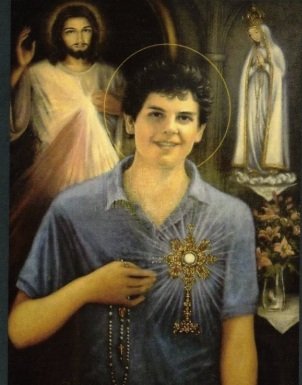
Prayer to Carlo Acutis for the Isolated Teen
In the Name of the Father, and of the Son, and of the Holy Spirit. Amen.
Dear Blessed Carlo Acutis, you lived as a teenager in our fast-paced, digital world, yet your heart belonged entirely to Jesus Christ!
Look with compassion upon my heart today. You know how noisy, overwhelming, and lonely the online world can be. You see how hard it is to stay faithful, pure, and authentic when everyone around me is chasing trends and algorithmic approval.
I ask you to be my heavenly friend and brother. When I feel left out, invisible, or misunderstood by my peers, remind me that I was created as an original, not a photocopy. Help me to find my true identity in Jesus, just as you did.
Obtain for me from God the grace to use technology wisely, the strength to set healthy boundaries, and the courage to stand up for my Catholic faith without fear. Teach me to love the Holy Eucharist as my own highway to Heaven.
Blessed Carlo, friend of young people and digital apostle, pray for me! Amen.
(Recite 1 Our Father, 1 Hail Mary, and 1 Glory Be)

Frequently Asked Questions
Is it a sin to spend a lot of time on social media or playing video games?
Spending time on technology is not inherently sinful, but it becomes problematic when it leads to addiction, neglect of your duties (like schoolwork or family time), exposure to immoral content, or the destruction of your interior prayer life. Moderation and self-control are key.
How do I handle being mocked or cancelled online for sharing Catholic views?
Remember the words of Jesus: “If the world hates you, know that it has hated me before it hated you” (John 15:18). Do not engage in aggressive online arguments or match toxic energy. State the truth with kindness, block abusive accounts, and take comfort in knowing that your loyalty lies with Christ, not the internet.
What should I do if I don’t have any Catholic youth groups or faithful friends near me?
Start by praying daily for God to bring at least one good Christian friend into your life. In the meantime, seek out solid Catholic podcasts, books, and verified online communities, while continuing to serve faithfully in your local parish and family.
Final Reflection
If you are a teenager feeling lost and alone in a crowded digital world, remember this simple truth: you were made for more than a screen.
Your value is not measured by likes, retweets, subscriber counts, or Snapchat streaks. Your dignity was bought at the price of the Cross, and your name is written on the heart of God.
Follow the pathway blazed by Blessed Carlo Acutis. Turn off the digital noise, look up from your phone, and step onto the real highway to Heaven. In the quiet presence of Jesus in the Eucharist, you will find the one Friend who will never scroll past your pain, never unfollow your soul, and never leave you alone.
About the Author
Wander Venerio C. de Freitas is a Brazilian Catholic theologian, educator, and author dedicated to promoting authentic Catholic spirituality through Sacred Scripture, Sacred Tradition, the Catechism of the Catholic Church, and the witness of the saints. Through The Lord of Peace, he publishes in-depth articles designed to help readers deepen their relationship with Jesus Christ, grow in faith, and discover the timeless wisdom of the Catholic Church.
Continue Reading on Our Website
Deepen your devotion and explore more inspiring Catholic resources:
50 Inspiring Saint Charbel Quotes That Will Strengthen Your Faith and Bring You Closer to God
Why Pray the St. Charbel Novena? A Complete Guide to the Spiritual Power of Nine Days of Prayer
10 Timeless Lessons from Saint Charbel That Can Transform Your Relationship with God
Why Do Millions of People Pray to Saint Charbel? The Extraordinary Faith Behind the Miracles
Finding Quiet Strength in Suffering Through Saint Charbel
10 Saint Charbel Quotes on Suffering That Offer Comfort in Hard Times
Powerful Saint Charbel Quotes for Healing and Physical Illness
What Saint Charbel Teaches Us About Redemptive Suffering
Five Days With Saint Charbel: A Free Catholic Devotional for Faith, Hope, and Prayer
Inspiring Saint Charbel Words for Caregivers and Loved Ones
Saint Charbel Quotes to Pray During Times of Bodily Weakness
Saint Charbel Quotes for Chronic Pain Warriors Seeking Hope
Finding Meaning in Pain: Timeless Lessons from Saint Charbel
Saint Charbel on Divine Mercy During Physical Affliction
Saint Charbel Quotes on Bearing Your Daily Cross with Grace
Encouraging Saint Charbel Quotes for Hospital Patients
The Most Inspiring Quotes of Saint Charbel: Words of Faith, Prayer, and Silence
Saint Charbel Quotes When Healing Seems Impossible
Saint Charbel for Catholics Who Are Still Faithful but Secretly Losing Hope