Saint Charbel: The Miracle Saint Who Continues to Transform Lives Around the World
Throughout history, God has raised up holy men and women whose lives became living signs of His love and mercy. Among these remarkable witnesses, few inspire as much devotion as Saint Charbel Makhlouf, the humble Lebanese Maronite monk whose legacy continues to touch millions of lives more than a century after his death. Every year, countless pilgrims travel to his monastery in Annaya, Lebanon, seeking healing, peace, and spiritual renewal. Others pray from their homes across the world, sharing testimonies of physical recoveries, restored families, renewed faith, and profound interior conversions through his intercession. His extraordinary popularity is not based merely on stories of miracles. Rather, it is rooted in a life completely surrendered to Jesus Christ—a life marked by humility, silence, prayer, sacrifice, and an unwavering love for the Holy Eucharist. Who was Saint Charbel? Why has this hidden monk become one of the most beloved Catholic saints in modern times? What can Christians today learn from his example? And what does the Bible and the Catholic Church teach about asking for the prayers of the saints?
In this comprehensive guide, we will explore the remarkable journey of Saint Charbel through Sacred Scripture, the Catechism of the Catholic Church, and the rich spiritual tradition of Christianity.
Who Was Saint Charbel?
Saint Charbel was born Youssef Antoun Makhlouf on May 8, 1828, in the mountain village of Bekaa Kafra, located in northern Lebanon. At more than 5,000 feet (1,600 meters) above sea level, the village is considered one of the highest permanently inhabited communities in the Middle East.
His childhood unfolded during a difficult chapter in Lebanese history. The country remained under Ottoman rule, and many villages struggled with poverty, political instability, heavy taxation, and recurring conflicts.
Life was far from easy.
Families depended almost entirely on agriculture, while uncertainty shaped everyday existence.
Yet it was precisely within these humble circumstances that God prepared one of the greatest mystics of modern Christianity.
📚 This article is part of the Ultimate Guide to St. Charbel
If you want to discover the complete story of St. Charbel Makhlouf—from his childhood, religious vocation, and monastic life to the miracles recognized by the Church, the mystery of his incorrupt body, his prayers, the novena, his powerful intercession, and his extraordinary path to holiness—be sure to visit our Ultimate Guide to St. Charbel, the most comprehensive resource on our website about this beloved Maronite saint.
A Childhood Shaped by Faith
From an early age, Youssef displayed an uncommon attraction to prayer and solitude.
While many children spent their days playing in the fields, he often sought quiet places where he could pray, meditate, and contemplate the beauty of God’s creation.
His mother, Brigitta, was a woman of deep Christian faith who nurtured in her son a sincere love for God and the Blessed Virgin Mary.
After the death of his father, she remarried a devout man who would later become a priest in the Maronite Church. Their home remained centered on prayer, trust in Divine Providence, and faithful participation in the sacramental life of the Church.
These early experiences planted the seeds of holiness that would eventually flourish throughout Charbel’s life.
Jesus teaches:
“For where your treasure is, there your heart will be also.” (Matthew 6:21)
For young Youssef, God quickly became that greatest treasure.
Suffering Often Prepares the Saints
Many people imagine that saints lived comfortable lives.
The opposite is usually true.
As a child, Youssef experienced the painful loss of his father, leaving his family in difficult economic circumstances.
Instead of becoming bitter, these hardships deepened his trust in God.
The Apostle Paul reminds believers:
“We know that in all things God works for the good of those who love Him.” (Romans 8:28)
This verse beautifully summarizes the early years of Saint Charbel.
Every hardship became an opportunity for spiritual growth.
Every sorrow strengthened his dependence upon the Lord.
Rather than turning away from God, suffering drew him closer to Him.
The Call That Changed Everything
As Youssef matured, he sensed an interior longing that no earthly success could satisfy.
He did not dream of wealth.
He did not seek political influence.
He had no desire for public recognition.
His deepest aspiration was to belong entirely to Christ.
Jesus had declared:
“If anyone would come after Me, let him deny himself and take up his cross daily and follow Me.” (Luke 9:23)
Those words became the guiding principle of Youssef’s life.
At the age of twenty-three, he quietly left his family home and entered the Lebanese Maronite Order, embracing a life of prayer, obedience, and simplicity.
Upon entering religious life, he received a new name:
Charbel.
The name honored an early Christian martyr from the Eastern Church whose faithful witness inspired generations of believers.
Throughout Scripture, receiving a new name often signifies a new mission entrusted by God.
Abram became Abraham.
Simon became Peter.
Saul became Paul.
Likewise, Youssef’s new name marked the beginning of an entirely new life dedicated to Christ.
The Meaning Behind the Name “Charbel”
The name “Charbel” carries profound spiritual significance.
It commemorates an early martyr who remained faithful to Christ despite persecution and suffering.
For the young monk, this was far more than a symbolic gesture.
It represented a complete surrender of his life to God.
Religious names have long reminded monks and nuns that Christian discipleship requires continual conversion.
Saint Paul expresses this transformation beautifully:
“It is no longer I who live, but Christ who lives in me.” (Galatians 2:20)
Few lives illustrate these words more perfectly than that of Saint Charbel.
Understanding the Maronite Catholic Church
To appreciate Saint Charbel’s spirituality, one must understand the tradition in which he lived.
The Maronite Church is one of the Eastern Catholic Churches in full communion with the Bishop of Rome.
While preserving its ancient Syriac liturgical heritage, it shares the same Catholic faith, sacraments, and apostolic mission as the universal Church.
Its spirituality emphasizes:
- continual prayer;
- fasting and self-denial;
- silence and contemplation;
- fidelity to the Holy Eucharist;
- devotion to the Blessed Virgin Mary;
- complete trust in Divine Providence.
These spiritual foundations profoundly shaped Saint Charbel’s entire life.
The Catechism of the Catholic Church teaches that the diversity of liturgical traditions beautifully reflects the richness and universality of Christ’s Church (see CCC 1200–1206).
The Maronite tradition stands as one of these precious treasures within Catholicism.
A World in Crisis… A Soul Seeking God
The nineteenth century witnessed political unrest, economic hardship, epidemics, and social instability across much of the Middle East.
Many sought security in power or wealth.
Charbel sought only God.
The Psalmist proclaims:
“God is our refuge and strength, an ever-present help in trouble.” (Psalm 46:1)
This conviction became the foundation of his entire spiritual journey.
When the world chose ambition, he embraced humility.
When society pursued comfort, he welcomed sacrifice.
When others filled their lives with noise, he chose silence.
His witness remains strikingly relevant today in an age marked by anxiety, distraction, and constant digital stimulation.
The Universal Call to Holiness
One of the greatest lessons from Saint Charbel’s life is that holiness is not reserved for extraordinary people.
The Catechism of the Catholic Church teaches that every baptized Christian is called to the fullness of holiness and to the perfection of charity (see CCC 2012–2016).
Saint Charbel answered that call in an exceptional way, but his journey began with ordinary acts of faithfulness:
daily prayer,
love for Scripture,
frequent reception of the sacraments,
humility,
obedience,
and unwavering trust in God.
His life reminds every Christian that true greatness is measured not by worldly success but by union with Jesus Christ.
A Legacy That Continues to Inspire Millions
More than one hundred years after his death, Saint Charbel remains one of the most beloved saints in the Catholic Church.
His example continues to inspire believers across cultures, languages, and continents because his life points to an eternal truth:
God still transforms the world through those who surrender themselves completely to His will.
In the next section, we will discover how Saint Charbel’s hidden monastic life, profound Eucharistic devotion, and years of solitude prepared him for the extraordinary legacy that continues to inspire countless believers around the world.
Saint Charbel: The Monastic Life, the Hermitage of Annaya, and the Secret of His Holiness
The Monastery: A School of Holiness
When Youssef Makhlouf entered the Lebanese Maronite Order, he did not seek comfort or recognition. He desired something far greater—to belong completely to Jesus Christ.
After receiving the religious name Charbel, he began years of intense spiritual formation, learning that holiness is built through countless hidden acts of obedience, humility, and perseverance.
Monastic life was demanding. Each day followed a disciplined rhythm centered on prayer, manual labor, silence, study, and worship. The monastery was not an escape from the world but a place where the soul could be transformed by God’s grace.
The Catechism of the Catholic Church teaches that every Christian is called to holiness according to his or her vocation, and consecrated religious bear a special witness by dedicating their entire lives to Christ (see CCC 914–933).
Saint Charbel embraced this calling with extraordinary fidelity.
Ordained to Serve Christ
After years of preparation, Charbel was ordained a priest in 1859.
For him, the priesthood was never about honor or authority.
It was participation in the eternal priesthood of Jesus Christ.
Every celebration of the Holy Mass became the center of his existence.
He believed that the Eucharist was the greatest treasure entrusted to humanity because Christ Himself becomes truly present under the appearances of bread and wine.
Jesus declared:
“I am the living bread that came down from heaven. Whoever eats this bread will live forever.” (John 6:51)
Saint Charbel built his entire spiritual life around this mystery.
Every Mass was celebrated with profound reverence, often lasting much longer than usual because of his deep recollection.
Those who witnessed him at the altar frequently testified that he appeared completely absorbed in prayer.
The Holy Eucharist: The Center of His Life
If there was one defining characteristic of Saint Charbel, it was his burning love for the Eucharist.
He understood that every spiritual transformation begins with Christ Himself.
The Catechism teaches:
“The Eucharist is the source and summit of the Christian life.” (CCC 1324)
For Saint Charbel, these words were not merely theological concepts.
They were daily reality.
He spent long hours in Eucharistic adoration, remaining silently before the Blessed Sacrament.
He believed that silence before Jesus often speaks more deeply than many words.
In today’s noisy world, his example offers a powerful lesson.
Sometimes the greatest prayer is simply remaining in God’s presence.
As Psalm 46 reminds us:
“Be still, and know that I am God.” (Psalm 46:10)
Silence: The Language of God
Modern society often fears silence.
Phones, social media, entertainment, and endless notifications fill every moment.
Saint Charbel lived the opposite way.
Silence became the atmosphere in which he encountered God.
This silence was not emptiness.
It was filled with attentive listening.
The prophet Elijah experienced God’s presence not in the earthquake, wind, or fire, but in a gentle whisper.
“After the fire came a gentle whisper.” (1 Kings 19:12)
Like Elijah, Saint Charbel discovered that God often speaks quietly.
His hidden life reminds Christians that interior silence allows the Holy Spirit to shape the heart.
A Life of Simplicity
Although respected by fellow monks, Saint Charbel deliberately avoided attention.
He owned almost nothing.
His clothing was simple.
His meals were modest.
His room contained only the necessities.
He believed that freedom from unnecessary possessions allowed the soul to become richer in God’s grace.
Jesus warned:
“Do not store up treasures on earth… but store up treasures in heaven.” (Matthew 6:19–20)
Saint Charbel lived these words literally.
His joy came not from material wealth but from communion with Christ.
The Call to the Hermitage
After many years in the monastery, Saint Charbel felt drawn toward an even deeper life of contemplation.
With permission from his superiors, he entered the Hermitage of Saints Peter and Paul, located near the Monastery of Saint Maron in Annaya.
This decision changed the remainder of his life.
The hermitage was small, isolated, and remarkably simple.
Few comforts existed there.
Its purpose was not comfort.
Its purpose was complete union with God.
For the next twenty-three years, Saint Charbel embraced the ancient tradition of the Christian desert fathers, dedicating himself almost entirely to prayer, fasting, manual work, and contemplation.
Following the Desert Fathers
Long before Saint Charbel, the earliest Christian monks left cities to seek solitude in the deserts of Egypt, Syria, and Palestine.
Figures such as Saint Anthony the Great and Saint Macarius inspired generations of monks to place God above every earthly attachment.
Saint Charbel became one of the greatest modern heirs of this spiritual tradition.
The Catechism reminds believers that throughout history the Holy Spirit has inspired men and women to withdraw into solitude in order to seek God with an undivided heart (see CCC 920–921).
His hermitage became a modern echo of the ancient Christian desert.
Prayer Without Ceasing
Saint Paul’s exhortation became the rule of Saint Charbel’s daily life:
“Pray without ceasing.” (1 Thessalonians 5:17)
His day began before sunrise.
Hours were devoted to:
- the Divine Office;
- meditation on Sacred Scripture;
- celebration of Holy Mass;
- Eucharistic adoration;
- manual labor;
- fasting;
- silent contemplation.
Prayer was not merely one activity among many.
Prayer became the atmosphere in which every activity was lived.
Whether working, walking, or resting, his heart remained turned toward God.
Fasting and Self-Denial
Modern culture often encourages constant comfort.
Saint Charbel chose voluntary sacrifice.
He practiced regular fasting, slept very little, and embraced simplicity with joy.
His goal was never to punish the body.
Rather, he sought greater freedom from selfishness.
Jesus Himself taught:
“Whoever wishes to come after Me must deny himself.” (Matthew 16:24)
The Church teaches that fasting helps believers grow in conversion, self-mastery, and love for God (see CCC 1434–1439).
Saint Charbel understood that authentic freedom comes when the soul governs earthly desires instead of being governed by them.
His Extraordinary Devotion to the Blessed Virgin Mary
Saint Charbel possessed deep filial love for the Blessed Virgin Mary.
Like many saints before him, he recognized Mary as the perfect disciple of Christ.
Every stage of his spiritual journey was entrusted to her maternal care.
At the foot of the Cross, Jesus entrusted His Mother to the beloved disciple:
“Behold, your mother.” (John 19:27)
The Church has always understood these words as extending spiritually to all believers.
The Catechism teaches that Mary’s maternal role continues in heaven as she intercedes for God’s children (see CCC 969–970).
Saint Charbel confidently entrusted his vocation, priesthood, and entire life to her protection.
Humility: The Foundation of His Sanctity
One remarkable feature of Saint Charbel’s life was his desire to remain unknown.
He never sought fame.
He never tried to impress others.
He simply desired that people see Christ.
Jesus taught:
“Whoever exalts himself will be humbled, and whoever humbles himself will be exalted.” (Matthew 23:12)
True holiness rarely seeks applause.
Saint Charbel’s hidden life demonstrates that greatness in God’s Kingdom often grows quietly.
Even after becoming widely respected among his fellow monks, he continued performing ordinary tasks with extraordinary love.
The Fruits of a Hidden Life
During his lifetime, Saint Charbel never traveled widely.
He wrote no famous theological books.
He founded no religious order.
He held no influential position within society.
Yet his hidden fidelity became more powerful than worldly success.
Jesus compared God’s Kingdom to a tiny mustard seed that grows into a great tree (Matthew 13:31–32).
Saint Charbel’s life perfectly illustrates this Gospel truth.
What appeared insignificant before the world became a source of spiritual renewal for millions.
Lessons for Christians Today
Saint Charbel speaks powerfully to modern believers.
His life reminds us that:
- intimacy with God matters more than popularity;
- silence strengthens the soul;
- frequent participation in the Eucharist transforms the heart;
- prayer is never wasted;
- humility prepares us for God’s grace;
- holiness begins with faithfulness in ordinary daily life.
In a world filled with distraction, his witness invites Christians to rediscover the beauty of contemplation and complete trust in Jesus Christ.
Looking Ahead
By the late 1890s, Saint Charbel’s earthly pilgrimage was approaching its final chapter.
No one could have imagined that after his death, extraordinary events would begin attracting pilgrims from every corner of the world.
Lights surrounding his tomb, an incorrupt body, mysterious healings, and thousands of reported miracles would make this hidden monk one of the most beloved saints of modern Christianity.
In Part Three, we will explore Saint Charbel’s final days, his holy death, the extraordinary signs reported after his burial, the Church’s careful investigation of his miracles, and why devotion to him continues to grow across the globe.
Saint Charbel: His Holy Death, Extraordinary Miracles, and the Church’s Recognition
A Life Hidden in God Reaches Its Final Chapter
For more than twenty-three years, Saint Charbel lived almost entirely in silence within the Hermitage of Saints Peter and Paul in Annaya. Few outside the monastery knew his name. He never sought recognition, never preached to large crowds, and never imagined that millions would one day invoke him as one of the greatest miracle-working saints of modern times.
Yet God often chooses what the world overlooks.
As Saint Paul writes:
“God chose what is foolish in the world to shame the wise; God chose what is weak in the world to shame the strong.” (1 Corinthians 1:27)
Saint Charbel’s hidden life reminds us that holiness is measured not by human applause but by complete fidelity to God’s will.
The Final Mass
On the morning of December 16, 1898, Saint Charbel celebrated what would become his final Holy Mass.
During the Eucharistic Prayer, while pronouncing the sacred words of the liturgy, he suddenly suffered a severe stroke (hemiplegia).
Unable to continue the celebration, he was carefully assisted by his fellow monks and taken to his small room in the hermitage.
Although physically weakened, his spirit remained fixed on Christ.
For the next eight days, he endured intense suffering with remarkable serenity.
Those who cared for him later testified that he accepted his pain without complaint, offering every moment to God.
His final days became a living reflection of the Apostle Peter’s exhortation:
“If anyone suffers as a Christian, let him not be ashamed, but let him glorify God.” (1 Peter 4:16)
A Death United to Christmas
On the evening of December 24, 1898, as Christians prepared to celebrate the birth of Jesus Christ, Saint Charbel peacefully surrendered his soul to God.
His earthly pilgrimage had ended.
He was seventy years old.
The monk who had spent decades hidden in silence entered eternal communion with the Lord he had loved so deeply.
Jesus had promised:
“Well done, good and faithful servant… Enter into the joy of your master.” (Matthew 25:23)
For those who knew Saint Charbel personally, there was little doubt that these words perfectly described his life.
A Simple Burial
Saint Charbel received the simple burial customary for Maronite monks.
He was laid to rest in the monastery cemetery without public ceremony or earthly honors.
No one expected that his grave would soon become one of the world’s most visited Catholic pilgrimage sites.
The humble monk who had desired anonymity remained unknown to almost everyone.
Only God knew what would soon unfold.
The Extraordinary Light Above the Tomb
Soon after his burial, villagers began reporting something unusual.
During the night, mysterious lights were repeatedly seen surrounding the place where Saint Charbel had been buried.
The phenomenon continued for several nights.
Curiosity spread throughout the region.
Local residents, monks, and Church authorities became increasingly interested in these reports.
Eventually, permission was granted to open the tomb.
What they discovered surprised everyone.
An Extraordinary Discovery
When Saint Charbel’s tomb was opened, witnesses reported that his body had remained remarkably preserved.
According to historical accounts preserved by the Maronite Church, the body showed an unusual flexibility and was accompanied by the presence of a mysterious fluid that attracted widespread attention.
Over the following decades, Church authorities repeatedly examined the body while carefully documenting their observations.
These events contributed greatly to the growing devotion surrounding Saint Charbel.
Thousands of pilgrims began visiting Annaya, convinced that God was glorifying His faithful servant.
The Church, however, acted with great prudence.
Rather than immediately declaring these events miraculous, ecclesiastical authorities carefully investigated every claim, following the Church’s long tradition of discernment.
Why Doesn’t the Church Base Holiness on Extraordinary Signs?
Many people assume that miracles alone make someone a saint.
The Catholic Church teaches otherwise.
Miracles may confirm God’s action, but they never replace a holy life.
The true foundation of sainthood is heroic virtue.
The Catechism teaches:
“The saints have always been the source and origin of renewal in the most difficult moments in the Church’s history.” (CCC 828)
Saint Charbel’s sanctity was recognized first because of his profound union with Christ.
The extraordinary signs surrounding his tomb served as confirmation—not the foundation—of his holiness.
Countless Reports of Healing
As devotion spread throughout Lebanon and beyond, pilgrims began reporting remarkable favors received through Saint Charbel’s intercession.
Many spoke of:
- unexpected physical healings;
- restored eyesight;
- recovery from paralysis;
- relief from chronic illness;
- conversion of family members;
- renewed faith;
- reconciliation after years of division;
- peace during serious illness.
Today, testimonies continue to arrive from every continent.
While not every reported healing is officially recognized as miraculous, they reveal the confidence millions place in Saint Charbel’s prayers before God.
James encourages believers:
“The prayer of a righteous person is powerful and effective.” (James 5:16)
Catholics understand this verse as applying not only to believers on earth but also to the saints who now live fully in Christ.
Can Saints Hear Our Prayers?
This is one of the most frequently asked questions by Christians.
The Catholic Church does not teach that saints possess divine power.
Only God answers prayer.
However, the Church teaches that those who have entered Heaven remain united with Christ and lovingly intercede for His people.
The Catechism explains:
“Being more closely united to Christ, those who dwell in Heaven fix the whole Church more firmly in holiness… They do not cease to intercede with the Father for us.” (CCC 956)
This belief flows naturally from the doctrine of the Communion of Saints, expressed every Sunday in the Apostles’ Creed.
Saint Charbel is honored not because he replaces Christ, but because his prayers lead believers more deeply to Christ.
As Saint Paul reminds us:
“There is one mediator between God and mankind, the man Christ Jesus.” (1 Timothy 2:5)
Catholic teaching fully affirms this truth.
The saints participate in Christ’s unique mediation by praying for us, just as Christians on earth pray for one another.
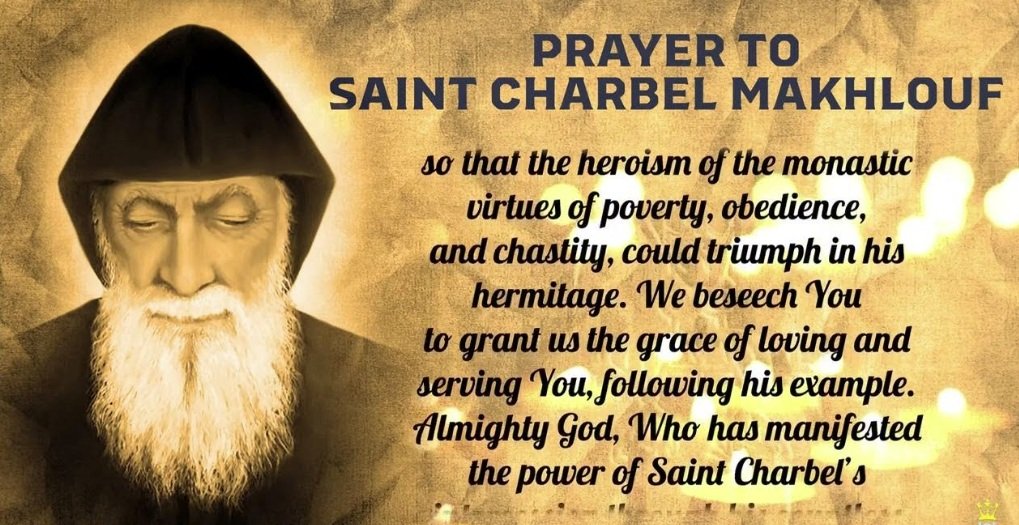
The Beatification of Saint Charbel
After decades of careful investigation into his life and reported miracles, the Church officially recognized Saint Charbel’s heroic virtue.
On December 5, 1965, during the Second Vatican Council, Pope Saint Paul VI beatified him.
In his homily, Pope Paul VI presented Charbel as a shining example of contemplative holiness, demonstrating that complete union with Christ remains possible in every age.
The beatification also introduced Saint Charbel to Catholics throughout the world.
Pilgrimages to Annaya increased dramatically.
Devotion spread across Europe, the Americas, Africa, Asia, and Oceania.
Canonization: A Saint for the Universal Church
Following the recognition of an additional miracle attributed to his intercession, Pope Saint Paul VI canonized Saint Charbel on October 9, 1977.
From that moment, the hidden monk of Annaya became officially recognized as Saint Charbel Makhlouf.
His feast day is celebrated annually on July 24 in the Roman Catholic calendar, while some Eastern Catholic communities commemorate him according to their own liturgical traditions.
His canonization reminds believers that sanctity is not reserved for famous missionaries, bishops, or theologians.
Even a monk who spent decades in silence can become a light for the entire world.
Why Do Millions Continue to Pray to Saint Charbel?
The answer extends far beyond the extraordinary stories of healing.
People are drawn to Saint Charbel because his life radiates authenticity.
He teaches modern Christians that:
- prayer has lasting power;
- silence allows us to hear God’s voice;
- suffering united with Christ has redemptive value;
- holiness is possible in every age;
- God’s grace transforms ordinary lives into extraordinary witnesses.
In a culture driven by speed, entertainment, and constant distraction, Saint Charbel points toward something deeper:
friendship with Jesus Christ.
The Greatest Miracle
Although physical healings often attract public attention, the Church consistently teaches that the greatest miracle is conversion.
Jesus declared:
“What does it profit a man to gain the whole world and forfeit his soul?” (Mark 8:36)
Saint Charbel understood this truth completely.
His deepest desire was never simply to relieve earthly suffering.
His greatest mission was to help souls encounter Christ.
Every authentic miracle ultimately points toward the Gospel.
Every grace received through the saints invites believers to love God more fully.
A Message for Our Time
Today’s world desperately needs witnesses like Saint Charbel.
His life proclaims that happiness cannot be purchased.
Peace cannot be manufactured.
Hope cannot be found merely in technology or material success.
True fulfillment comes from living in communion with God.
As Jesus promised:
“Peace I leave with you; My peace I give to you.” (John 14:27)
Saint Charbel spent his entire life receiving that peace—and continues to inspire millions to seek it.
Coming Next
In Part Four, we will explore the biblical foundation for asking the saints to pray for us, what the Catechism teaches about the Communion of Saints, practical spiritual lessons from Saint Charbel’s life, an original prayer for his intercession, answers to the most frequently asked questions, and a powerful conclusion inviting every reader to grow closer to Jesus Christ through the witness of this extraordinary saint.
Saint Charbel: Biblical Foundations, the Communion of Saints, Practical Lessons, and a Prayer for His Intercession
Why Do Catholics Ask Saint Charbel to Pray for Them?
One of the most common questions about Saint Charbel concerns the Catholic practice of asking saints for their prayers.
Some wonder whether this takes away from the unique role of Jesus Christ.
The answer is clear:
No.
The Catholic Church teaches that Jesus Christ alone is the Savior of the world and the one Mediator between God and humanity (1 Timothy 2:5). Every grace comes from God through Christ.
When Catholics ask Saint Charbel—or any saint—to pray for them, they are not worshiping the saint or replacing Christ. They are asking a faithful disciple of Jesus, now in Heaven, to join them in prayer before God.
This is similar to asking a friend, pastor, or family member on earth to pray for us.
The difference is that the saints already enjoy the fullness of eternal life in God’s presence.
The Communion of Saints
Every Sunday, Christians profess in the Apostles’ Creed:
“I believe in the Communion of Saints.”
This ancient profession expresses one of the most beautiful realities of Christian faith.
The Church is one family.
Some members are still living on earth.
Others are being purified.
Others already rejoice forever in Heaven.
Together they remain united in Christ.
The Catechism explains:
“The Communion of Saints is the Church.” (CCC 946)
Because death cannot separate those who belong to Christ, the bonds of charity continue beyond earthly life.
Saint Paul beautifully describes the Church as one living body:
“Now you are the body of Christ, and individually members of it.” (1 Corinthians 12:27)
That unity is never broken.
Are the Saints Alive?
Scripture answers this question directly.
Jesus Himself declared:
“He is not God of the dead, but of the living, for to Him all are alive.” (Luke 20:38)
Those who die in friendship with God do not cease to exist.
They live with Christ.
Their love for the Church continues.
For this reason, the Catechism teaches:
“Being more closely united to Christ, those who dwell in Heaven… do not cease to intercede with the Father for us.” (CCC 956)
Saint Charbel’s intercession is therefore understood as an expression of Christian charity that continues beyond death.
The Saints Present Our Prayers to God
One of the clearest biblical images appears in the Book of Revelation.
Saint John writes:
“The twenty-four elders fell before the Lamb, each holding a harp, and golden bowls full of incense, which are the prayers of the saints.” (Revelation 5:8)
Again, Revelation says:
“The smoke of the incense, together with the prayers of God’s people, went up before God.” (Revelation 8:3–4)
These passages portray the heavenly Church actively presenting the prayers of God’s people before His throne.
For Catholics, this provides a beautiful biblical image of heavenly intercession.
Surrounded by a Great Cloud of Witnesses
The Letter to the Hebrews offers another remarkable passage.
After recounting the heroes of faith, Scripture declares:
“Therefore, since we are surrounded by so great a cloud of witnesses, let us also lay aside every weight and sin.” (Hebrews 12:1)
The saints are not distant historical figures.
They remain living witnesses whose example encourages Christians to persevere in faith.
Saint Charbel belongs to this great cloud of witnesses.
His life continues to point countless believers toward Christ.
Why Is Saint Charbel So Closely Associated with Healing?
Throughout the Gospels, Jesus repeatedly healed the sick.
These miracles revealed both His divine power and His compassionate love.
Saint Charbel never claimed healing power for himself.
Every authentic grace attributed to his intercession ultimately points to Christ.
The Church carefully investigates alleged miracles before officially recognizing them.
Medical experts, theologians, and canonical commissions examine each case with great care.
This careful process demonstrates that the Church does not encourage blind credulity.
Rather, she seeks truth with prudence.
Whether physical healing occurs or not, every sincere prayer can become an occasion for spiritual renewal.
Sometimes God heals the body.
Sometimes He strengthens the soul.
Sometimes He grants the grace to carry suffering with hope.
In every case, His love remains constant.
What Saint Charbel Teaches Modern Christians
Saint Charbel’s witness remains remarkably relevant in today’s world.
His life reminds us that true holiness grows quietly through daily faithfulness.
Among his greatest lessons are:
1. God Speaks in Silence
Modern life is filled with constant noise.
Saint Charbel teaches us to create space for prayer, reflection, and attentive listening.
As Psalm 46 says:
“Be still, and know that I am God.”
2. The Eucharist Is the Heart of Christian Life
Saint Charbel’s extraordinary devotion to the Blessed Sacrament reflected the Church’s constant teaching.
The Eucharist is not simply a symbol.
It is Christ Himself, truly present.
The Catechism proclaims:
“The Eucharist is the source and summit of the Christian life.” (CCC 1324)
3. Holiness Is Possible for Everyone
Many people believe sainthood belongs only to extraordinary individuals.
The Gospel teaches otherwise.
Every baptized person receives the universal call to holiness.
The Catechism states:
“All Christians… are called to the fullness of Christian life and to the perfection of charity.” (CCC 2013)
Saint Charbel simply responded generously to that invitation.
4. Suffering Can Become a Path to Grace
No one seeks suffering.
Yet when united to Christ, suffering can deepen faith and hope.
Saint Paul writes:
“I rejoice in my sufferings for your sake.” (Colossians 1:24)
Saint Charbel accepted illness, sacrifice, and hardship without bitterness.
His peaceful endurance continues to inspire believers facing their own crosses.
5. Humility Opens the Heart to God
Saint Charbel never sought popularity.
Ironically, his humility became one reason millions now know his name.
Jesus taught:
“Whoever humbles himself will be exalted.” (Matthew 23:12)
True greatness begins with surrender.
An Original Prayer Through the Intercession of Saint Charbel
O glorious Saint Charbel,
faithful servant of Jesus Christ,
you chose silence instead of worldly praise,
prayer instead of distraction,
and holiness instead of comfort.
From Heaven, where you now rejoice in the presence of the Lord,
intercede for all who seek your prayers.
Obtain for us stronger faith,
greater trust in God’s providence,
and hearts that remain faithful even during suffering.
Help us to love the Holy Eucharist,
to treasure Sacred Scripture,
to remain devoted to the Blessed Virgin Mary,
and to seek God’s will above every earthly desire.
If it is according to God’s holy plan,
pray that those who suffer from illness,
loneliness,
fear,
or discouragement
may receive comfort, healing, and renewed hope.
Above all,
lead us ever closer to Jesus Christ,
so that one day we may rejoice together in the eternal Kingdom of Heaven.
Amen.
Frequently Asked Questions About Saint Charbel
Who was Saint Charbel?
Saint Charbel Makhlouf was a Lebanese Maronite monk and priest (1828–1898) known for his life of prayer, silence, and profound devotion to the Eucharist. He was canonized by Pope Saint Paul VI in 1977.
Why is Saint Charbel famous?
He is widely known because of the many reported healings and spiritual favors attributed to his intercession, as well as his extraordinary witness of holiness.
Is Saint Charbel the patron saint of healing?
Although he is not officially designated as the universal patron saint of healing, countless faithful throughout the world seek his intercession for physical, emotional, and spiritual healing.
Where is Saint Charbel buried?
His tomb is located at the Monastery of Saint Maron in Annaya, Lebanon, where thousands of pilgrims visit each year.
What is Saint Charbel’s feast day?
In the Roman Catholic Church, Saint Charbel’s feast is celebrated on July 24.
Does the Catholic Church officially recognize his miracles?
Yes. The Church carefully investigated miracles attributed to his intercession during both his beatification and canonization processes. Many additional testimonies continue to be reported by pilgrims around the world.
Final Reflection
The story of Saint Charbel is not primarily about extraordinary miracles.
It is about extraordinary faith.
He teaches us that the greatest transformation begins in the hidden places of the heart.
Long before the world knew his name, God knew him.
Long before pilgrims visited his tomb, heaven rejoiced in his fidelity.
His life reminds every Christian that holiness is possible in every generation.
Whether we are called to family life, priesthood, religious life, or the ordinary responsibilities of daily work, the invitation remains the same:
to love God above all things.
As Jesus promises:
“Seek first the Kingdom of God and His righteousness, and all these things shall be given to you as well.” (Matthew 6:33)
May the witness of Saint Charbel encourage each of us to pray with greater confidence, to trust God’s providence more deeply, and to walk faithfully with Christ until the day we share in the joy of all the saints.
About the Author
Wander Venerio Cardoso de Freitas is a theologian, educator, and author of books on Catholic spirituality, the lives of the saints, and Christian formation. He is the founder of the portal O Senhor Te Dê a Paz (Saints Library), dedicated to evangelization through articles, books, and digital content.
Continue Reading on Our Website
Deepen your devotion and explore more inspiring Catholic resources:
📖 Saint Charbel: The Miracle Saint Who Still Changes Lives Today
📖 30 Días con San Charbel Makhlouf: Un Camino de Silencio, Fe y Abandono Total en Dios
📖 The Incorrupt Body of Saint Charbel: The Extraordinary Mystery That Continues to Inspire the World
📖 50 Inspiring Saint Charbel Quotes That Will Strengthen Your Faith and Bring You Closer to God
📖 Why Pray the St. Charbel Novena? A Complete Guide to the Spiritual Power of Nine Days of Prayer
📖 10 Timeless Lessons from Saint Charbel That Can Transform Your Relationship with God
📖 Why Do Millions of People Pray to Saint Charbel? The Extraordinary Faith Behind the Miracles
📖 THE LIFE AND MIRACLES OF SAINT CHARBEL: A POWERFUL BOOK THAT WILL STRENGTHEN YOUR FAITH
📖 30 Days With St. Charbel Makhlouf: The Catholic Devotional Transforming Lives Through Silence and Total Surrender